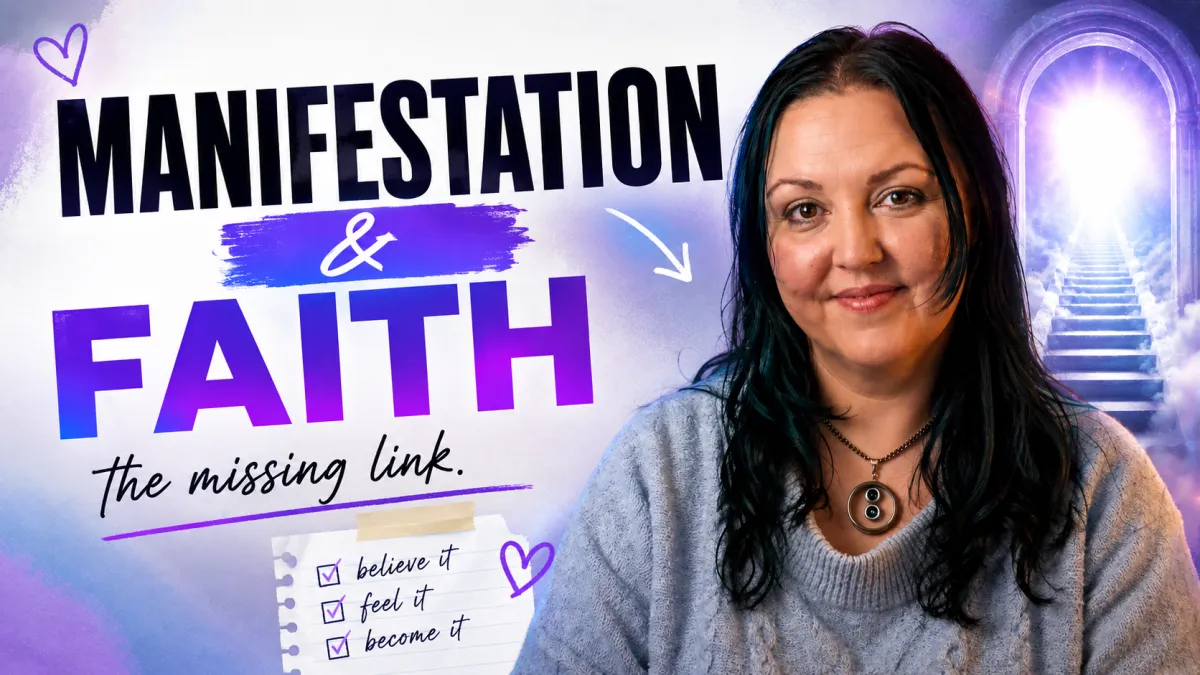
14. Where Does Faith Fit Into Manifestation?
Episode 14 | Where Does Faith Fit Into Manifestation? | 1st September 2026 | 20 min




Watch the full episode on YouTube
💌 The Glow-Up Gazette: your weekly dose of inspiration and momentum. Come for the personal growth, stay for the stories, rabbit holes, recs and occasional overshare. Plus a monthly Glow Getter prize draw. You in? → https://minddrophq.com/glowupgazette
I believe God opens doors. I also believe I have to get off my butt and walk through them.
Where does faith and spirituality fit into manifestation, and what about your role in it? Jodi's shares her personal take on holding faith and neuroscience at the same table, without forcing either one to explain the other away.
She gets into what science can actually measure about belief, where manifestation tips over into blame, and why faith doesn't let you off the hook for your own part. It's the finale of the four-part manifestation miniseries.
KEY TAKEAWAYS
Faith and evidence don't have to compete
You can care deeply about neuroscience and still believe in something a lab can't measure. Science can study what belief does inside a person: how it affects stress, hope, persistence, and how much uncertainty you can sit with. What it can't do is prove a specific outcome was caused by God. Both can sit on the same table without one having to explain the other away.
Manifestation turns damaging when it becomes blame
There's a version where not getting what you wanted means you weren't aligned enough, doubted too much, or didn't trust properly. That version ignores health, money, access, timing, other people's choices, and everything outside your control. You can believe deeply, pray, work hard and still not get the exact outcome you pictured. Influence isn't the same thing as control.
Your internal world still counts
None of that makes what's happening inside you irrelevant. What you believe and expect, and the way you carry yourself, can change what you notice, how long you keep going, what you say yes to, and how much your nervous system can stay with once the thing becomes real. That's real influence, without collapsing it into a formula.
Faith doesn't remove your responsibility
The door opening is one thing. What you do once it's open is yours. Faith here means trusting while you walk, not waiting beside the road to be carried, and you can surrender what you can't control without surrendering your own participation.
NOTABLE QUOTES
"Life isn't a vending machine where you insert the correct frequency and the results just drop out."
"That's when somebody's beautiful story starts being used to explain somebody else's pain."
"For me, it's not my participation or God, it's my participation and God."
TIMESTAMPS
0:00 The Spark
0:07 Intro
0:47 Where Faith and Spirituality Fit
2:41 What Can We Actually Measure?
5:08 And Then There's Energy
6:29 Where Manifestation Gets Messy
8:44 What About The People Who Get What They Envisioned?
10:12 Faith and the Two Pathways
10:57 Faith Opens The Door
13:37 Outwitting the Devil
14:37 So Did They Actually Manifest It?
16:05 Wrapping Up
18:55 Outro
Hey Gorgeous, Your Next Step Starts Here...
You can pray over it, picture it, feel completely connected to it, and still have to do the work that's yours to do. Inner Spark is where you build the nervous system capacity to actually walk through the door when it opens: regulation tools, tapping, guided neuro-rewiring, real-life integration and the Spark Seekers community, to help you create the life you love that loves you right back.
→ Join Inner Spark: https://minddrophq.com/innerspark
And if you're stuck in survival mode, run off your feet or feeling a little overwhelmed, the Nervous System Emergency Kit is free, with practical regulation tools ready to go → https://minddrophq.com/emergencykit
KEY REFERENCES
Ano, G. G., & Vasconcelles, E. B. (2005). Religious coping and psychological adjustment to stress: A meta-analysis. Journal of Clinical Psychology, 61(4), 461–480. https://doi.org/10.1002/jclp.20049
Hill, N. (2011). Outwitting the devil: The secret to freedom and success (S. Lechter, Ed.). Sterling. (Original work written 1938)
COMMON QUESTIONS
Can you hold faith and still believe in manifestation?
Yes, and this episode sits right in that overlap. You can believe you're guided, supported and provided for, and also accept that what you believe and expect shapes how you act, what you notice, and how long you keep going. Where it gets shaky is the version that treats faith like a formula, where getting your internal state exactly right guarantees the outcome.
What does the research say about faith and coping?
A 2005 meta-analysis by Gene Ano and Erin Vasconcelles looked across 49 studies on religious coping. When people's faith left them feeling supported and held, results showed better coping. When it left them feeling punished, abandoned, or like they'd spiritually failed, findings revealed poorer coping. It's correlational, so it shows what belief is associated with inside a person, not proof that faith causes a particular outcome.
Is manifestation real or just confirmation bias?
Both explanations can be partly true at once, which is the whole point of this episode. Belief can change your behaviour: what you pay attention to, what you're willing to ask for, how long you persist. Some of that we can observe through psychology and biology. Other parts, like whether God arranged a specific meeting, sit in belief rather than anything science can measure. You don't have to pick one lane.
Why didn't my manifestation work even though I believed and prayed?
Because outcomes aren't fully in your control. Other people have free will, circumstances change, your own priorities shift, and health, money, access and timing all play a part. You can believe deeply, pray, work hard and still not get the exact thing you pictured, and that isn't evidence that belief is wrong or doesn't work. The version of manifestation that blames you for the outcome is the version this episode pushes back on.
What's the difference between faith and manifestation?
Manifestation, in this episode, is about the interplay between your internal world and what actually shows up in your life. Faith is trust in something bigger than you: guidance, support, and sometimes a vision you don't understand yet. The two aren't in competition. Faith can run through either pathway, whether you build belief from a vision or from the next visible step, but it still asks you to move.
Does your energy attract things to you?
For me, yes, and it works on more than one level. There's the physical, observable side: your attitude, the way you carry yourself, how you look at a situation, and the cues other people read off you before a word is spoken. And there's the spiritual and energetic side: the inner work you do, the way that shifts your external world, and what you then decide to make a move on. Both change what starts coming toward you, and for me, they work together.
TRANSCRIPT
[00:00:00] The Spark
I believe God opens doors, but I also believe I have to get off my butt and walk through them
[00:00:07] Intro
[00:00:47] Where Does Faith & Spirituality Fit?
Where does God fit? And where does our responsibility fit? These are questions I keep coming back to when we talk about manifestation because this part of it [00:01:00] I don't feel gets explored much. We hear the science conversation and we hear the manifestation thoughts becomes things conversation.
We hear people talk about prayer and energetics and divine timing, the universe, visualization, and even alignment.
What we don't often do is put all of that on the same table and then ask what belongs where. So that's what I kind of wanna do here. And upfront, this is personal and it's not so simple. It's a very nuanced conversation.
I believe in God and I care about evidence and neuroscience. Those things aren't exclusive of one another or in conflict for me, and I don't need science to prove every part of my faith before I feel like I'm allowed to believe it
I believe I'm looked after and provided for. I believe that God can guide me and open doors and bring people into my life, arrange timing in ways that I can't even begin to imagine how He does, [00:02:00] and create opportunities that I just couldn't have manufactured through my own strategy alone.
There have been times where I've been given a vision for something before I even understood what it was, and it wasn't necessarily coming from my own desire.
My responsibility still sits and exists inside all of that, though. If I believe that God has opened a door, I still have to notice it and use discernment and decide what I'm gonna do with that. And if I walk through, whatever happens next is going to usually ask something of me.
Faith doesn't mean that I sit there waiting for God to live my life for me and I'm passive about it
[00:02:41] What Can We Actually Measure?
There are parts of faith that science can study. We can look at what belief does inside a person, how it affects stress and hope and persistence and meaning of their lives, and how much uncertainty someone can sit with.
Whenever I use the word God, you can interchange that with what works for you. So that [00:03:00] might be universe or source or higher power or whatever it might be.
When somebody believes deep down that they're supported by God and that their life has meaning, that the chapter that they're in isn't the end of the story, it can change how they move through it.
It can help them keep going when there's not much evidence yet that things will actually improve, and it can help them come back after a disappointment, like that bounce back, And also carry it all as less of a weight on their own shoulders. It kind of allows us to offload some of that, if you will.
Faith can also shape the values someone makes decisions from, and faith communities can offer incredible support to one another through relationships and practical help and introductions and opportunities and such things
Researchers Gene Ano and Erin Vasconcelles looked at around, 49 studies on faith and coping, and found some really interesting insights.
When someone's faith had them feeling supported and helped, it tended to go [00:04:00] with better coping. And when their faith had them feeling punished or abandoned or like they'd spiritually failed, it tended to, be correlated with poorer coping. So we can study what faith does inside a person.
What we can't do is look at one event and prove that God caused it.
We can't prove God arranged a specific meeting, that the prayer changed one exact outcome, or that someone's energetic frequency pulled in a particular opportunity.
That's where we move out of measurable mechanisms and into belief it's the trust in something we can't see.
If I tell you I believe God opened a door for me, I'm telling you how I understand something that happened in my life.
It's a very different thing from saying science has actually proven that God will hand you every outcome that you visualize correctly.
And the reverse holds true as well.
We can't scientifically verify divine intervention, and that doesn't automatically mean that nothing spiritual happened. It just means we can't [00:05:00] verify it
that's part of the faith, right? It's having that faith in something we don't see. It's believing in something bigger than us.
[00:05:08] And Then There's Energy
Then we introduce the word energy, and this makes things even more interesting because two people can have a very different idea of what this word means.
If someone says they walked into a room and they could feel the energy, like, you know, when you feel like it's exciting or you can feel that it turned icy, there are parts of that that we can actually explain biologically. We're reading the tone of voice, a facial expression, body posture, all these tiny little cues that we pick up on constantly,
so you don't consciously think, "Interesting, her shoulders are sitting about three centimeters higher than her usual, and her voice has changed." You just think something feels off or something's weird about this. Your brain and nervous system are working through the information before you've got a conscious explanation of it more often than not
Then there's the [00:06:00] metaphysical use of the word, right? And this is where people are talking about frequency and vibration and universe and like attracting like. The idea that your internal energetic state has some direct line to what shows up in your external world, and that's a different type of claim.
Some of what we call energy has mechanisms that we can actually observe through psychology, biology, and how humans read one another. Other parts, however, sit in belief,
[00:06:29] Where Manifestation Gets Messy
This is where I start to have a problem with some of the versions of manifestation, on one extreme, every spiritual experience gets reduced to probability, networking, confirmation bias, and brain chemistry.
There's no mystery, there's no providence, and nothing beyond what we can currently measure. That's not how I see the world. Like I said earlier, it's more nuanced.
But I don't buy the other extreme that's out there either, and this is the one where someone [00:07:00] doesn't get what they wanted, and the explanation becomes that they weren't aligned enough, or they doubted too much, or they attracted the illness, or created the abuse, or failed to trust properly because they decided to take actual practical real-life action
And that's where this turns damaging, because spirituality almost becomes weaponized and starts turning into blame.
It can ignore health, and money, and access, and discrimination, and timing, and privilege, and other people's choices and circumstances completely outside of a person's control. And suddenly, if the outcome doesn't come, the person is left believing that they've failed to manifest it properly.
And I don't believe that. You can have faith, believe deeply, pray, work hard, and still not get the exact outcome you pictured. Sometimes you don't even understand it at all, and sometimes you don't understand it for months or years [00:08:00] later, and then you go, "Ah, hindsight, I tells ya."
Other people have free will. Circumstances change. Your own priorities in life change. Something that looked perfect from a distance can turn out to be completely wrong for you once you're actually close enough to it to see it properly. Life isn't a vending machine where you insert the correct frequency and the results just drop out.
There are so many more moving parts to this. But that doesn't make our internal world irrelevant either
What we believe and expect and the way that we carry ourselves and our attitude can shape what happens next. So yes, I believe we can influence outcomes enormously. Influence just isn't the same thing as total control
[00:08:44] What About The People Who Get What They Envisioned?
So what about the people who got exactly what they envisioned? This is where the manifestation stories get really interesting because someone spends years picturing an outcome. They pray over it, believe it, feel connected to it before it exists, and then one day it actually happens.
If that person [00:09:00] tells me God provided that, I'm not sitting there thinking, "Well, actually, let me explain confirmation bias to you."
It may be exactly how they experienced it. I've got experiences in my own life that I interpret spiritually too. I know God has played a hand in it.
But what we don't hear nearly as often is from the person who prayed and believed and pictured it and took action, and then still didn't get that exact result.
And that doesn't take anything away from the first person's experience by any means. It just means we have to be careful about turning one story into an actual formula.
There may have been all kinds of things happening at once. And they may also believe that God did something in their life that can't be reduced to any mechanism at all.
I'm comfortable with both of those things being true. What I don't want is for that story to turn into, "They believed correctly and therefore received it, so if you didn't receive yours, you must have believed wrong," or, "You can't manifest [00:10:00] something," or, "You're not, you know, like, connected," or whatever it might be.
That's when somebody's beautiful story starts being used to explain somebody else's pain, and I'm not really into that side of it.
[00:10:12] Faith and the Two Pathways
Earlier in this manifestation series, I talked about two different ways that people build belief.
Some people borrow belief from vision, and other people build it through evidence. I don't think faith needs to be a separate third pathway. It can run through either of those.
For someone who works through vision, it might feel like God has placed something on their heart before they understand how it's gonna happen. That's an experience I know very well.
For someone who builds through evidence, faith might look less like seeing the whole future and more like trusting that next step. They may not know where it's all going, but they trust that they're being led somewhere and they follow.
One person's working from the vision, the other person's from that visible next step, but both still have to take that action. Neither gets to hand the whole thing over and call it faith.
[00:10:57] Faith Opens The Door.
Which brings me back to where we started. I believe [00:11:00] God opens doors, and sometimes I believe He gives me the vision long before the door even appears.
Sometimes that vision makes absolutely no sense to me when I first get it. I often see something without understanding the how like, how am I gonna pull it off and how am I gonna get it from here to there?
So I tend to sit with it and I'll pray about it, and I let myself picture it and go into my imagination, and I pay attention to what keeps coming back.
Then life starts handing me information. It could be that a conversation happens or an opportunity shows up. Someone makes this beautiful introduction to one of their acquaintances that actually helps me move forward with something, or there's an idea that lands and it connects to something else.
Something that made, like, zero sense to me six months ago starts making sense all of a sudden, and that's where I see God moving.
Then there's my part. Once that opportunity is in front of me, I've gotta do something with it, [00:12:00] otherwise it's gone. It's like the Shakespeare, "There's a tide in the affairs of men" quote. , I can't remember it off by heart, but it's a good one and it illustrates this point, that much I do know. so maybe I decide to answer the email or make that call or have that conversation with, that person that, you know, has made the introduction, and I learn something. I prepare properly or I regulate my nervous system enough so I can walk into a room that feels just a bit bigger than anything I've handled before.
So the, the door opening is God's part, but what I do once it's open, that's up to me.
And once I walk through that door, I'm still paying attention because sometimes that door leads to exactly where I thought it would, and it's super fun and exciting.
Sometimes it doesn't, and it's sad and disappointing and can be even hurtful at times. In those moments, I choose to learn what I can from that situation, and I allow [00:13:00] myself to grow through it.
And then sometimes that door closes, or I realize that I read it wrong, or it was never my door to begin with, and that's where I trust that I'm being protected. That door wasn't meant to be for me. It's protecting me. I might not see that at the time either. That can come later as well.
And that's why discernment is important, because not every opportunity is divine instruction, and not every closed door is spiritual interference either.
I can believe God is guiding me and still think it through for myself, so I can hold both of those at once
[00:13:37] Outwitting the Devil.
One of my favorite books is the book called "Outwitting the Devil." I don't tend to look at it as a neuroscience textbook by any means because it isn't one. I find it to be more philosophical than anything. But its distinction between drifting and having a definite purpose I feel fits really well in this conversation that we're having.
So drifting is passive. You're [00:14:00] getting pulled around by fear and pressure and distraction or somebody else's agenda without really deciding where you're going
definiteness of purpose gives you direction, and faith can hold that direction steady when you can't see the whole road yet. But purpose does not mean sitting still waiting for certainty. Like, you could be waiting for forever. It changes the decisions you make and the discipline you're willing to build.
So for me, faith isn't sitting back beside the road asking for God to do all the walking. It's trusting Him while I walk and having Him walk alongside me
[00:14:37] So Did They Actually Manifest It?
When somebody says, "I thought about it, I felt connected to it, I prayed over it, and it arrived," did they actually manifest it?
I don't think the answer comes down to one mechanism here
Their belief could have changed what they noticed and how they behaved. It could have influenced them and helped keep them going longer and helped them say yes [00:15:00] to something they may have normally avoided or built enough nervous system capacity to stay with the thing once it started becoming real.
And they may believe that God was in it with them.
I believe God has been a part of many things in my life, and I don't need to prove it in a scientific way before I know that to be true or I share that with you.
And this is where the either/or framing kinda loses me. I don't feel like we have to decide that science explains it or that God did it.
I don't think we have to decide whether we created the result or it was handed to us
The way I experience life is far more layered than that. What I believe shapes how I move. My nervous system shapes what I can tolerate. My choices shape what happens next, and other people and circumstances kinda shape their part in it too.
And I believe that God moves through all of that. For me, it's not my [00:16:00] participation or God, it's my participation and God
[00:16:05] Wrapping Up
So where does faith fit into manifestation? For me, it's woven through the whole thing, and that might look a little different for you, and that's totally cool. I'm really interested in how everyone experiences this so differently, 'cause it depends if you have faith or a spiritual background or not. All of those things are okay.
For me, sometimes I have a vision before I understand it, and I believe that vision came from God. It's different to my own desires. Sometimes I know exactly what I want, I do desire it, and I pray over it. Sometimes I've got no idea where I'm going, and faith looks more like trusting the next step. And sometimes life is really freaking hard, and those valleys are low, and they're dark, Yet I believe that that is not where I'm ending up. It is just a journey through, and I have faith that I can do it. [00:17:00] I can learn from my time in there, and I'm gonna develop the character and the person that I need to be to be the next evolution of myself.
I can trust His timing and still send that email. I can pray over something, picture it, feel it, and feel connected to it, and then get up and do the work that's mine to do.
I've still gotta climb that hill. I've still gotta walk through that valley. I can surrender what I can't control without surrendering my own participation, without losing my own action.
And I don't need to choose between understanding the mechanisms that I can see, and believing that there are things moving way beyond them.
Across this series, we've looked at what happens inside of us when we imagine a different future, how belief gets built, what happens when our internal operating system calls BS on the thing we're trying to create, and how regulation and rewiring and real action, changes what we're [00:18:00] actually able to move toward.
Faith sits alongside all of that for me. It isn't a replacement for action, but it's not also a guarantee that I'll get every outcome that I want. And it isn't something I'd use to blame myself or anyone else if life takes a different turn
It's my relationship with God. It's trust and guidance, and sometimes a vision I, I don't understand yet. I believe God can open the door, and I believe sometimes He shows me something on the other side of it before I have any idea how I'm gonna get there. But when that door appears, I'm still the one standing there that needs to decide what I'm gonna do with that, and then take that action, whatever that may be.
And that wraps up our four-part miniseries on manifestation. Thanks for hanging out, and I'll see you next week
[00:18:55] Outro
Explore: Nervous System Emergency Kit || Inner Spark || Sonic Success || Desire Rewire || The Glow Up Gazette


