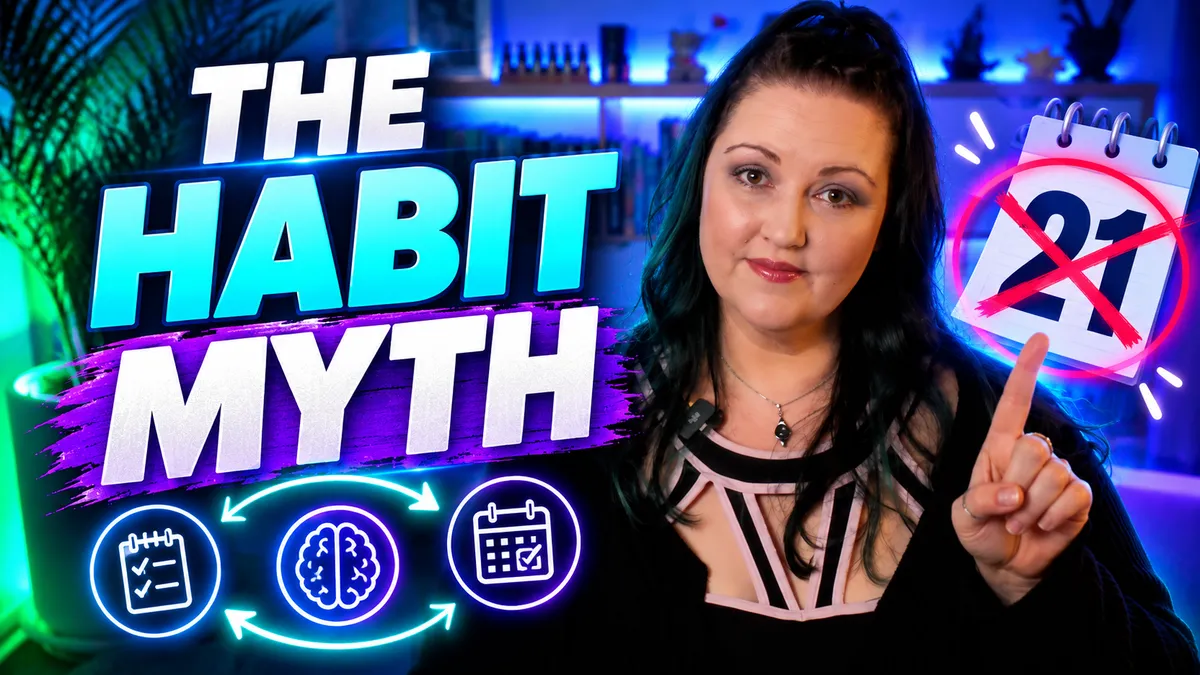
20. How to be Consistent: Habits, Routines and the 21 Day Myth
Episode 20 | How to be Consistent: Habits, Routines and the 21 Day Myth |
13th October 2026 | 15 min



Watch the full episode on YouTube
💌 The Glow-Up Gazette: your weekly dose of inspiration and momentum. Plus our monthly prize draw. You in? → https://minddrophq.com/glowupgazette
What if the reason you can't make something a habit is because it was never one behaviour to begin with?
We talk about consistency as though the end goal is to turn everything into a habit. Repeat something enough and eventually, surely, you should stop having to think about it. Except that's not quite how human behaviour works.
In this episode, Jodi unpacks the difference between habits and routines, how cues and recurring contexts help automaticity develop, and why a complex behaviour like going to the gym can contain several habitual pieces without the whole thing ever becoming one automatic sequence.
She also looks at why the exact same routine can feel easy one week and much harder the next, how nervous system capacity fits into consistency without becoming the explanation for everything, where the 21-day habit rule actually came from, and what the research can — and can't — tell us about how long habits take to form. Because consistency doesn't require putting your entire life on autopilot.
KEY TAKEAWAYS
Habits and routines aren't the same thing
A habit is a response that becomes increasingly automatic through repetition in recurring contexts. A routine is the broader structure you follow, and it can contain several habits alongside behaviours that still need conscious thought.
Cues help automaticity develop
Repeating a behaviour around a consistent cue — such as a time, place or preceding action — gives your brain a predictable relationship to learn. Over time, that cue can make the behaviour easier to initiate with less conscious deliberation.
Starting can become habitual even when the whole behaviour doesn't
Research distinguishes between habitual instigation — starting a behaviour — and habitual execution — moving through it. Your cue to head to the gym might become highly automatic while the workout itself still requires judgement, attention and flexibility.
Consistency can be a capacity problem or a design problem
Stress, poor sleep and emotional load can reduce the cognitive capacity available for complex behaviours. But sometimes the routine itself simply creates too much friction, so ask: Was today a capacity thing, or is the way I've set this up asking too much of me?
There is no magic number for forming a habit
The popular 21-day rule didn't come from controlled habit research, and current evidence doesn't support replacing it with 66 or 90 days either. Habit formation varies considerably depending on the behaviour, person, frequency and context.
Make the starting point predictable
Rather than trying to automate an entire complex behaviour, create a reliable cue and first response. Keep the structure consistent, then allow flexibility inside it — making the predictable parts easier without trying to put your whole life on autopilot.
NOTABLE QUOTES
"You can absolutely be consistent with something your brain never puts on autopilot."
"Was today a capacity thing, or is the way that I've set this up asking too much of me?"
"Capacity you build. Design you can change, fix and realign."
"The goal isn't to put your life on autopilot. It is to use automaticity where it helps and keep yourself in the driver's seat where it doesn't."
CHAPTERS
00:00 The Spark
00:45 What Are Habits?
03:15 Why Cues Are Important
04:21 Starting vs Doing
05:42 Complex Behaviour Still Needs You
06:47 Two Wednesdays
08:27 How Long Does It Take to Form a Habit?
12:02 How to Form a Habit
13:15 Today's Takeaways
Hey Gorgeous, Your Next Step Starts Here...
🧠 Free Nervous System Emergency Kit: a circuit breaker for the moment your nervous system feels overwhelmed or hijacked. Emotional regulation tools → Grab your free kit: https://minddrophq.com/emergencykit
🌟 Inner Spark: the coaching membership that helps you build capacity, regulate and rewire, so your past stops dictating your future → Get Your Spark Back: https://minddrophq.com/innerspark
KEY REFERENCES
Arnsten, A. F. T. (2009). Stress signalling pathways that impair prefrontal cortex structure and function. Nature Reviews Neuroscience, 10(6), 410–422. https://doi.org/10.1038/nrn2648
Lally, P., van Jaarsveld, C. H. M., Potts, H. W. W., & Wardle, J. (2010). How are habits formed: Modelling habit formation in the real world. European Journal of Social Psychology, 40(6), 998–1009. https://doi.org/10.1002/ejsp.674
Maltz, M. (1960). Psycho-cybernetics: A new way to get more living out of life. Prentice-Hall.
Phillips, L. A., & Gardner, B. (2016). Habitual exercise instigation (vs. execution) predicts healthy adults' exercise frequency. Health Psychology, 35(1), 69–77. https://doi.org/10.1037/hea0000249
Singh, B., Murphy, A., Maher, C., & Smith, A. E. (2024). Time to form a habit: A systematic review and meta-analysis of health behaviour habit formation and its determinants. Healthcare, 12(23), Article 2488. https://doi.org/10.3390/healthcare12232488
Wood, W., & Rünger, D. (2016). Psychology of habit. Annual Review of Psychology, 67, 289–314. https://doi.org/10.1146/annurev-psych-122414-033417
Zhu, L., Tao, Y., Zhou, B., Ma, H., Kaushal, N., Ma, X., Guo, Y., Zhao, R., Oguntuase, S. B., Li, H., & Zhang, L. (2026). Not all cues are equal: A systematic review and three-level meta-analysis of context consistency, physical activity and habit strength. Applied Psychology: Health and Well-Being, 18(4), Article e70204. https://doi.org/10.1111/aphw.70204
COMMON QUESTIONS
What's the difference between a habit and a routine?
A habit is a response that becomes increasingly automatic after being repeated in recurring contexts. A routine is the broader structure or sequence you repeatedly follow. A routine can contain several habits alongside behaviours that still need planning, judgement or conscious thought.
How do cues help habits form?
When a behaviour repeatedly follows the same cue — such as a time, place or preceding action — the brain has repeated opportunities to learn that cue-response relationship. Over time, the cue can make the behaviour easier to initiate with less conscious deliberation.
Can going to the gym actually become a habit?
Parts of it can. The starting sequence may become highly habitual — for example, finishing work, changing clothes and leaving for the gym. Once you're there, the workout may still require attention, judgement and flexibility.
What's the difference between habitual instigation and habitual execution?
Habitual instigation refers to automatically starting a behaviour. Habitual execution refers to how automatically you move through the behaviour once you've started. A complex behaviour can have a highly habitual starting point without the entire sequence becoming automatic.
How long does it take to form a habit?
There isn't one scientifically established number. Habit-formation research shows considerable variation depending on the person, behaviour, repetition frequency and context. Current research doesn't support treating 21, 66 or 90 days as a universal rule.
Is the 21-day habit rule true?
No. The 21-day idea traces back to observations made by plastic surgeon Maxwell Maltz and described in his 1960 book Psycho-Cybernetics. It wasn't originally established through controlled habit-formation research.
Does it take 90 days to form a habit?
There isn't good evidence supporting 90 days as a universal rule either. Habit formation varies too much between different people, behaviours and contexts for one number to apply to everything.
Does missing one day ruin a habit?
No evidence suggests one missed opportunity automatically resets the process. In Phillippa Lally and colleagues' study, one missed opportunity did not meaningfully disrupt habit formation. The useful focus is returning to the cue-response pairing rather than treating one missed day as starting again from zero.
Why can the same routine feel easy one week and difficult the next?
The routine may be identical while your available capacity is completely different. Sleep, stress, emotional load and the demands you've already handled that day can change how much working memory, judgement and self-regulation you have available for the parts of the behaviour that still require conscious input.
How do I know whether inconsistency is a capacity problem or a routine problem?
Ask two questions: Was today a capacity thing? Or is the way I've set this up asking too much of me? If your available capacity is low, regulation and recovery may help. If the routine creates unnecessary friction every time, changing the design may be the more useful intervention.
How can I become more consistent?
Make the beginning of the behaviour predictable. Choose a reliable cue, pair it with the same first action repeatedly, and keep enough flexibility inside the routine to respond to real life. You don't need the whole behaviour to become automatic in order to become consistent with it.
TRANSCRIPT
[00:00:00] The Spark
What if the reason you can't make something a habit is because it was never one behavior to begin with?
[00:00:05] Intro
[00:00:45] What Are Habits?
So this whole episode came about because I was writing some teaching material for Inner Spark this week. And as I was writing about behavioral consistency, I found myself about to say something along the lines of, "Going to the gym isn't really a habit because complex behaviors can't become habits."
Which is kinda true, but it's not really the full picture either. So if you think about people that you know who train after work, some of them finish up, they grab their gym bag, they're halfway down the road before their brain's even had a chance to start negotiating whether they feel like training or not.
Something in that is clearly running on its own, like on autopilot. So the nerd that I am got my research mode on and found out some really cool stuff. I remember touching on this in my motivational psychology class some time ago. So it was really fun to jump back into it again because it's a topic I quite like.
Wendy Wood, one of the big names in habit research, describes habits as responses that develop through repeating behaviors in reoccurring contexts. So rather than thinking of a habit as simply something that you do a lot, it's more useful to think about what is controlling the behavior.
And this is where cues come in. If you repeatedly perform the same behavior in the same kind of context, things within that context can begin to cue the response. That might be a time of day or a location or something that you always do immediately beforehand.
So think about this as an example. You get into the car and you put on your seatbelt. You walk into the bathroom in the morning and you reach for your toothbrush. The cue and the behavior have been paired together so many times that you don't have to decide what comes next anymore. That's part of how automaticity develops.
So repetition on its own isn't really the whole story. It's repetition in a sufficiently consistent context that allows the brain to learn that relationship between the cue and the response. A routine, however, is broader than that. It's the repeated structure or sequence that you tend to follow, and there might be multiple habits sitting inside it alongside things that still need conscious thought.
So going back to the gym side of things, your gym routine might be consistent without every single thing you do in the gym being a habit. The routine gives you the structure, habitual response can form within that.
[00:03:15] Why Cues Are Important
A 2026 meta-analysis led by Lianghao Zhu brought together 14 studies and more than 6,000 people looking specifically at physical exercise, content consistency, and habit strength.
They found that more consistent contexts were associated with stronger physical activity habits. The effects weren't huge, which is important to mention, but the timing and routine consistency were among the cues more clearly associated with how frequently people exercised.
So this isn't go to the gym at exactly 5:00 and your brain will magically automate exercise. That would be nice, but it's much more subtle than that. A stable context is what gives your brain something predictable to learn. So if every Monday, Wednesday and Friday, finishing work at 5:00 is followed by changing clothes, grabbing your bags, and leaving for the gym, then 5:00 itself starts to carry that information. " This is what we do next." So you've reduced one of the decisions involved in exercising before you've even arrived.
[00:04:21] Starting vs Doing
Researchers Alison Phillips and Benjamin Gardner looked this specifically with exercise, and they separated what they call habitual instigation from habitual execution. So instigation is starting the behavior. Execution is moving through the behavior itself.
So imagine that you train Monday, Wednesday, Fridays. 5:00 comes around and you change, grab your bag, and leave. That starting sequence might become increasingly automatic because it keeps occurring around the same cues.
But once you're actually in the gym, things can change. Maybe the machine you plan to use is taken, we all love when that happens. Or your shoulder is feeling a little niggly and you need to change things up a little bit. Uh, you might have slept badly and, like, today's weights feel super heavy compared to what they did three days ago.
Now your conscious thought is useful. You address what's happening, and you change the workout accordingly. So rather than asking whether going to the gym is or isn't a habit, we can be much, much more precise. The start can become highly habitual. Even parts throughout the workout can become habitual. But the larger behavior itself can still require attention and judgment and flexibility, and all of those things can exist at the same time.
[00:05:42] Complex Behaviour Still Needs You.
So Let's jump out of the gym and jump into running a business. There will be things that you often do enough that there is absolutely no benefit in deciding how to do them from scratch every morning. So maybe when you sit down at your desk, the first thing you do is open Trello or your calendar, and you see what you're working on before you even open your email inbox.
Over time, sitting down to work can become the cue for that first action. Sweet. We removed a decision that we didn't need, And that reduces our decision fatigue. But running the business itself still isn't a habit because clients change and priorities shift and something that you expected to work now doesn't or something broke and new information comes in and you actually need to decide what you're gonna do with that now. That's where your conscious thought really earns its keep.
So consistency isn't about removing conscious thought from everything that you do. It's about not spending conscious thought on the parts that you don't need it, so you've got more available for the parts that do.
[00:06:47] Two Wednesdays
All right, so that one person that's training, imagine that person but on two different Wednesdays. So last Wednesday, they slept well, work was pretty chill, and they've still got enough petrol in the tank when 5:00 rolls around again. This Wednesday, however, they didn't get the greatest night's sleep, and the day's been really relentless, and they spent the afternoon dealing with something that really got underneath their skin.
5:00 still rolls around, the cue itself, the 5:00, is identical. The person walking up to it is running on a completely different tank of energy
Amy Arnsten's research on stress and the prefrontal cortex, which is that part of your brain that I call the CEO, which is the thinking, planning, executive functioning side of things, shows that stress can knock out some of the functions we lean on for planning and self-control, like working memory.
So, the parts of a behavior that need decisions and adjusting get a whole lot harder when you're already running on low. This is where nervous system regulation and capacity comes into it, because your capacity on the day is gonna change things.
Now, in saying that, I'm not gonna turn every missed session into a nervous system problem, because when the gym's 45 minutes away and you've booked yourself in straight after a 10-hour day, it, that might actually just be a badly designed routine, not a capacity issue.
So when the plan goes sideways, there are two questions that are worth asking. Was today a capacity thing, or is the way that I've set this up asking too much of me?
Building capacity will help you work with the demands that are in front of you. Good structure and design removes demands that didn't need to be there in the first place, and the consistency gets much easier when you know which one that you're dealing with.
[00:08:27] How Long Does It Take To Form A Habit?
Let's talk about the 21 days thing because I hear this everywhere, and lately I'm even hearing 90 days or three months as well. 21 days to form a habit traces back to a plastic surgeon called Maxwell Maltz. In his 1960s book, Psycho-Cybernetics, he noticed his patients seemed to get used to their new face in about three weeks.
That's legitimately where it came from. One surgeon's observation about people adjusting after surgery, and somehow it became the rule for everything from flossing to running. How? And then, and the 90 days thing, I actually couldn't find good evidence on that as a universal habit rule either. It seems to be another nice round number that has been repeated often enough to sound scientific.
So what does the research actually say about habit formation?
A 2024 review led by Ben Sing and the University of South Australia pulled together 20 studies on health habits. Only four of those studies, however, measured how long it took, and the middle of the pack landed around two months. The range between people ran from a handful of days to nearly a year. Now, before you go sticking like 66 days on a Post-it Note, that midpoint comes from a small number of studies, and the researchers themselves are calling for bigger and better studies to be conducted. So I'm not gonna hand you like a magic number 'cause there isn't one.
What we can talk about is why some habits form fast and others take their sweet time. Generally, behaviors that are easier to repeat frequently in that stable context gives automaticity a much better chance to develop. A glass of water with breakfast gives your brain a much simpler cue response pairing to learn than a workout that requires you to get changed, drive somewhere, make decisions, and adjust as you go.
It also helps when the behavior feels good fairly quickly. And Science Review found that habits people chose for themselves and ones that are done in the morning tended to be stronger and easier to form. So when something's taking a little longer than you expected or would like, there's a decent chance you've kind of picked a harder one to put together. And say for the things that are on their way to becoming a habit, missing a day here or there doesn't wipe your learning that your brain's already done and that pairing that's already happened.
Philippa Lally and Jane Wardle's team found one missed opportunity didn't meaningfully set the habit back. So keep pairing that cue and the action, and give it a little longer than feels reasonable, and you'll probably find that it will still form. Some things, however, may never become a habit at all, though. Even in studies set to specifically build habits with a simple behavior and a cue people chose for themselves, not everyone got there.
And frequency makes a difference simply because repetition gives that cue response relationship more opportunities to strengthen. If something happens once a week, your brain gets far fewer chances to practice that pairing than it does when something happens every morning.
And the more complexity and fresh decision-making that a behavior asks of you, the less likely or slower the whole thing is to actually become a habit, which takes us kind of right back to where we started.
Those are usually the bundles. The whole thing may never run on autopilot, but the start of it, that initiation still can, and then your routine capacity carry the rest. You can absolutely be consistent with something your brain never puts on autopilot.
[00:12:02] How To Form A Habit
So if you're trying to become more consistent with something, i'd recommend not starting by asking how you can turn the entire thing into a habit. I recommend that you find the starting point and make that part predictable.
So if it's exercise, perhaps the routine is Monday, Wednesday, Fridays after work, or perhaps it's the minute you get up, you put your shoes on, you head out the door for a walk before anything else. So finishing work becomes the cue or getting up out of bed becomes the cue.
Changing into your training clothes is then the first response. You keep pairing those things together. That's what you're giving your brain the opportunity to learn. Then once you've started, you keep a little bit of flexibility, so the workout doesn't have to be identical every Wednesday for that routine to hold, or the walking route that you go doesn't have to be the same every time.
You can respond to how much time you have, what your body is doing and what it needs and what makes sense for you on the day. But the structure itself stays consistent. The behavior inside it can adapt, and that's structured flexibility, and it gives you something much more useful than trying to automate your entire life and create a whole bucket load of habits.
You're making the predictable parts easier whilst keeping conscious thought available where conscious thought is actually valuable
[00:13:15] Today's Takeaways
So consistency isn't about getting to a point where you never have to think about what you're doing again.
Habits can support the consistency by making certain responses easier to initiate when familiar cues are present. Routines then give those behaviors some structure and some predictability, and the more complex parts still needs your attention, judgment, and capacity.
And when the plan goes, like, sideways, check whether it was a capacity thing or whether it was a design thing before you make it mean anything about you.
Capacity you build. Design you can change, fix, and realign.
So build reliable cues around things that you repeat. Reduce unnecessary decisions where you can, and leave yourself enough flexibility to respond intelligently when life doesn't look the same as it did last week.
The goal isn't to put your life on autopilot. It is to use automaticity where it helps and keep yourself in the driver's seat where it doesn't. See you next week
[00:14:19] Outro
Explore: Nervous System Emergency Kit || Inner Spark || Sonic Success || Desire Rewire || The Glow Up Gazette


