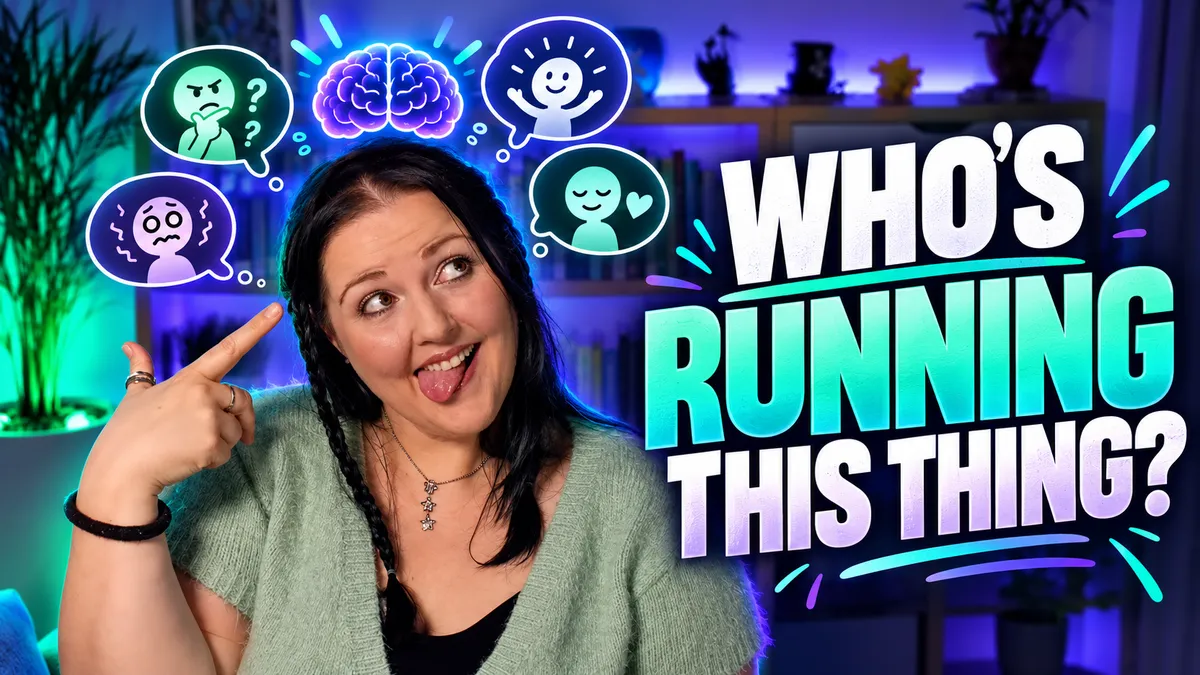
21. My Brain Needs a Staff Meeting (Why We Do the Weird Things We Do)
Episode 21 | My Brain Needs a Staff Meeting (Why We Do the Weird Things We Do) | 20th October 2026 | 12 min



Watch the full episode on YouTube
💌 The Glow-Up Gazette: your weekly dose of inspiration and momentum. Plus our monthly prize draw. You in? → https://minddrophq.com/glowupgazette
I reckon our brains need a staff meeting, 'cause quite frankly, someone's not passing on the messages.
You walk into a room, forget why you're there, walk back out, remember ... and then promptly forget again. Meanwhile, your brain can rehearse an entire argument with someone who hasn't even joined the conversation yet.
For an organ capable of astonishing intelligence, creativity and problem-solving, the human brain can be spectacularly ridiculous.
In this episode, Jodi puts the brain's imaginary departments on notice. From the doorway effect and mental rehearsal to the CEO, guard dog, apps and autopilot, she explores why these odd little experiences happen — and what the psychology and neuroscience actually tell us.
It's a lighter side of Human Evolution, with plenty of laughs and one important distinction: not every unusual thought or behaviour is a nervous system survival response. Sometimes our brains are simply doing what brains do.
Because learning about yourself matters. But so does being able to have a giggle along the way.
KEY TAKEAWAYS
The doorway effect is real, but not inevitable
Moving between environments can sometimes make a recently held intention harder to retrieve. Research suggests the effect depends on context and competing mental demands; walking through a doorway does not automatically erase your memory.
Imaginary conversations can be useful rehearsal
Mentally simulating what might happen helps us prepare for future situations. But it is worth noticing when preparation turns into repeatedly replaying the same imaginary conversation.
Talking to yourself can help organise your thoughts
Inner speech and speaking aloud can serve useful cognitive functions. As Jodi shares, she often processes out loud — which is not nearly as unusual as we might think.
The CEO, guard dog and apps are helpful metaphors
They make conscious planning, rapid threat detection and conditioned responses easier to picture. They are not literal characters or complete descriptions of how the brain operates.
Autopilot saves mental effort
Familiar routines can become increasingly automatic, freeing up conscious attention for other things. Occasionally it means you start driving the usual way to work when you meant to go somewhere else.
Not every brain quirk is a problem to solve
Some experiences have ordinary explanations in attention, memory, prediction or habit. We can be curious about our brains without pathologising every funny human moment.
NOTABLE QUOTES
“I reckon our brains need a staff meeting, 'cause quite frankly, someone's not passing on the messages.”
“Your brain just filed the paperwork somewhere, like, really inconvenient.”
“Am I actually preparing for this conversation, or am I just replaying it?”
“Sometimes our brains are simply doing what brains do.”
“Sometimes it's also worth appreciating just how ridiculously funny being human can be.”
CHAPTERS
00:00 The Spark
01:02 The Wonderful Weirdness of the Human Brain
02:02 The Memory Department Has Lost the Paperwork
03:19 The Imaginary Conversations Department
05:50 Management Has Entered the Chat
08:05 The Autopilot Department
09:41 The Beautiful Ridiculousness of Being Human
Hey Gorgeous, Your Next Step Starts Here...
🧠 Free Nervous System Emergency Kit: a circuit breaker for the moment your nervous system feels overwhelmed or hijacked. Emotional regulation tools → Grab your free kit: https://minddrophq.com/emergencykit
🌟 Inner Spark: the coaching membership that helps you build capacity, regulate and rewire, so your past stops dictating your future → Get Your Spark Back: https://minddrophq.com/innerspark
KEY REFERENCES
Alderson-Day, B., & Fernyhough, C. (2015). Inner speech: Development, cognitive functions, phenomenology, and neurobiology. Psychological Bulletin, 141(5), 931–965. https://doi.org/10.1037/bul0000021
Diamond, A. (2013). Executive functions. Annual Review of Psychology, 64, 135–168. https://doi.org/10.1146/annurev-psych-113011-143750
LeDoux, J. E. (2012). Rethinking the emotional brain. Neuron, 73(4), 653–676. https://doi.org/10.1016/j.neuron.2012.02.004
McFadyen, J., Nolan, C., Pinocy, E., Buteri, D., & Baumann, O. (2021). Doorways do not always cause forgetting: A multimodal investigation. BMC Psychology, 9, Article 41. https://doi.org/10.1186/s40359-021-00536-3
Radvansky, G. A., Krawietz, S. A., & Tamplin, A. K. (2011). Walking through doorways causes forgetting: Further explorations. The Quarterly Journal of Experimental Psychology, 64(8), 1632–1645. https://doi.org/10.1080/17470218.2011.571267
Schacter, D. L., Addis, D. R., & Buckner, R. L. (2007). Remembering the past to imagine the future: The prospective brain. Nature Reviews Neuroscience, 8(9), 657–661. https://doi.org/10.1038/nrn2213
Wood, W., & Rünger, D. (2016). Psychology of habit. Annual Review of Psychology, 67, 289–314. https://doi.org/10.1146/annurev-psych-122414-033417
COMMON QUESTIONS
Why do I forget what I was doing when I walk into another room?
One possible explanation is the doorway effect. Crossing an event boundary can change how an intention is organised or retrieved from memory. The effect isn't universal and can be influenced by factors such as competing memory demands.
Why do I have imaginary conversations in my head?
Mental simulation helps us prepare for possible future interactions and practise responses. It can be useful planning, but it may become unhelpful if you keep replaying the same scenario rather than moving forward.
Is talking to yourself normal?
Yes. Inner speech is a common part of human thinking, and speaking out loud can sometimes help people organise or work through their thoughts. In this episode, Jodi shares that she's an outward processor.
Why does a message like 'Can we talk later?' make me overthink?
An ambiguous message can invite predictions about what might happen next. Prior experiences and learned responses can influence the interpretation, but it doesn't automatically mean your nervous system has detected danger.
Why do I sometimes drive my usual route without intending to?
Practised behaviours can become more automatic when familiar cues are present. This is often useful because it reduces the conscious attention needed for routine actions — although occasionally it leads you towards work instead of your intended destination.
Does every strange little behaviour have a trauma or nervous system explanation?
No. Some quirks are everyday features of attention, memory, simulation and learned habits. As Jodi says, sometimes our brains are simply doing what brains do.
TRANSCRIPT
[00:00:00] The Spark
Tell me, have you ever walked into a room, stopped dead in your tracks, and thought, "Hang on. Why am I here again?" Like, you had a very specific reason for coming in here, and now absolutely nothing. I reckon our brains need a staff meeting, 'cause quite frankly, someone's not passing on the messages.
[00:00:22] Intro
[00:01:02] The Wonderful Weirdness of the Human Brain
Okay, my friend. So today we're gonna do something a little different. We spend a fair amount of time on this podcast talking about some pretty big things. Nervous system regulation, behavioral patterns, subconscious conditioning, the way our brains work, and challenging some of the things that are out there.
But today I wanna talk about some of the wonderfully ridiculous things that our brains do. Because for something as extraordinary as the human brain, capable of incredible feats of intelligence, creativity, and problem-solving, it can also be spectacularly useless at remembering why we walked into the laundry. I mean, like, come on.
And what's fascinating is that some of these silly little experiences actually have some interesting psychology and neuroscience behind them. So let's start with one of them from the beginning, shall we?
[00:02:02] The Memory Department Has Lost The Paperwork
That thing where you walk into a room and forget why you're there, it's actually been studied, weirdly enough. And it's sometimes called the doorway effect. Researchers have found that moving between different environments can make it harder to remember what you were just doing. Now, it doesn't happen every single time, and some research suggests it's more likely when we've already got a lot on our minds.
But one explanation is that our brains organize experiences into, like, little events or chapters. I like to call them segments. And when our surroundings change, our brains can shift their attention to the new situation, which means the thing that was important 10 seconds ago suddenly becomes a little harder to retrieve.
So it's not necessarily that you've forgotten what you've needed, Your brain just filed the paperwork somewhere, like, really inconvenient.
And the funniest part, sometimes when you walk back into the original room, like, you remember, right? "Oh, that's it. That's what I needed." And then off you go again. And if you forget for a second time, well, I think that's grounds for a formal performance review.
[00:03:19] The Imaginary Conversations Department
All right, so here's another fun one. Have you ever had an entire conversation with someone who wasn't actually there? Not just thinking about what you might say, I mean, like, a full-blown conversation. You've explained your position beautifully, and they've responded. You've created their response, and You've even countered that argument. You've made some excellent points if you do say so yourself, and somewhere along the way, you've probably won the argument. Congrats.
The other person hasn't even turned up yet, and the really annoying thing is when you finally have that conversation in real life, they don't follow your script. Like, excuse me, uh, we rehearsed this.
Now, as ridiculous as that sounds, there is a reason we do it. Our brains are capable of mentally simulating future experiences. We can imagine possible outcomes, practice what we might say, and anticipate how somebody else could actually respond to us. It's an incredibly useful ability, and, anyone who is logical, or strategic will typically, lean into this quite a lot.
It helps us to prepare, to plan, and to navigate social situations, and also talking to ourselves, whether silently or out loud, can also help us organize our thinking. I, for one, are definitely an outward processor. I talk things out loud all the time, and I'm pretty sure anyone who is around me, like if I'm walking around my house figuring stuff out, probably would think I'm nuts.
But sometimes, what I can find and what we can see is that helpful rehearsal can become a bit of a loop, especially when we're anticipating something uncomfortable. So instead of preparing for the conversation once, we start running version two, version three, the director's cut, the sliding door moment, and suddenly we've spent, like, 45 minutes having an argument with someone who is probably sitting at home eating toast, completely unaware that there's a courtroom drama happening in our head.
So the next time you catch yourself doing this, think about this question to ask yourself: Am I actually preparing for this conversation, or am I just replaying it? You know, there's a little bit of a difference between the two.
And if you're on your seventh imaginary argument, perhaps it's time to adjourn the meeting.
[00:05:50] Management Has Entered The Chat
Now, if you've been listening to Human Evolution for a while, yay, thank you, you'll remember we've got a couple of characters in our brain.
We've got the CEO. It's a prefrontal cortex heavily involved in reasoning, planning, conscious decision-making, emotional regulation, and also, like, our language centers are up in there as well.
We've got the guard dog, and this is our metaphor for the brain's rapid threat detection processes, including the amygdala.
And then we've got the apps, those automatic conditioned responses like Groundhog Day that can run before we've consciously decided how we wanna actually behave. These are metaphors, obviously, right? Your brain is a lot more complex than, you know, the, the little office building that we're giving it.
But just imagine for a moment that these guys actually had to attend a staff meeting. Play with me here.
So the CEO calls up everyone together and says, "Come on. Right, team, let's go. We're gonna be calm and thoughtful and make some sensible decisions." Cool. Sounds like a good plan.
And then a message from somebody arrives saying, "Can we talk later?"
The guard dog immediately sits up. "Talk? Talk about what?" The CEO is like, "Hey man, like we don't actually have enough information yet." But the guard dog is already like, it's got questions. Why don't they say what it was about? Did something happen? Are we in trouble? And at the same time, one of the old apps sitting at the table has already started running its familiar response, right? Perhaps checking whether we've upset somebody or maybe mentally reviewing the last conversation, rereading the text, whatever it might be.
Meanwhile, the CEO is like desperately trying to establish some form of order. "Can everyone please just calm down?" And this, my beautiful friends, is why management is requesting an emergency meeting, because all these different processes can influence how we respond, often before we've had a lot of time to think.
Of course, not every unusual thought means that your guard dog is on high alert, and not every quirky, weird behavior that we do is a conditioned survival response. Sometimes our brains are simply doing what brains do.
[00:08:05] The Autopilot Department
Then we've got autopilot, which for the record is actually a brilliant feature. Our brains learn familiar routines so we don't have to consciously think through every tiny action.
Imagine having to concentrate on every single movement involved in brushing your teeth or every step of making a cup of coffee. You'd be exhausted before breakfast even hit the table. So as we learn and repeat things, many actions become increasingly automatic, which is wonderful. Automaticity is a beautiful thing. Habits can be really great...
until you leave the house intending to go somewhere different only to realize that you started driving your usual route to work. Like, hang on. Uh, no, we're not going there today. Who the heck approved this? It's like someone in the autopilot department saw a familiar set of circumstances, stamped the paperwork, and sent you on your way.
No meeting or consultation, just business as usual.
And while all these little moments can be frustrating, they can also show us something really important about how the brain operates. A lot of what we do doesn't require our full conscious attention, so how much are we walking around on autopilot?
Most of the time, it's actually kind of a good thing. It's what makes us fairly efficient, although I'd really appreciate it if someone could explain to me why I can remember the lyrics to a song I haven't heard in 20 years, but I can't remember where I put my phone, like, 30 seconds ago. Priorities, people.
[00:09:41] The Beautiful Ridiculousness of Being Human.
So there we have it. An extraordinary brain capable of planning for the future, learning incredible skills, solving complex problems, and creating entire imaginary conversations. Yet occasionally unable to navigate between two rooms without losing the plot.
What I love about understanding the brain is the more that we learn about it, the more we can appreciate just how fascinating human behavior really is. And I think we can afford to have a little more fun with that, be a little bit playful.
We spend so much time trying to understand ourselves and improve ourselves and become better at being human.
Like, that's a great goal to have. It's wonderful. And you know I'm all for that. It's literally why I do what I do. But sometimes it's also worth appreciating just how ridiculously funny being human can be.
So the next time you catch yourself rehearsing a conversation that hasn't happened yet or wandering aimlessly around the house trying to remember what you were doing, just have a little laugh about it.
Perhaps call an emergency staff meeting. Although judging by today's performance, I'm not entirely convinced anyone will turn up.
And if you're curious about the science behind all of these wonderful weirdnesses, I've actually popped all the research and references in the show notes for you to explore, because yes, there is actual science behind this madness.
I will see you next week
[00:11:12] Outro
Explore: Nervous System Emergency Kit || Inner Spark || Sonic Success || Desire Rewire || The Glow Up Gazette


