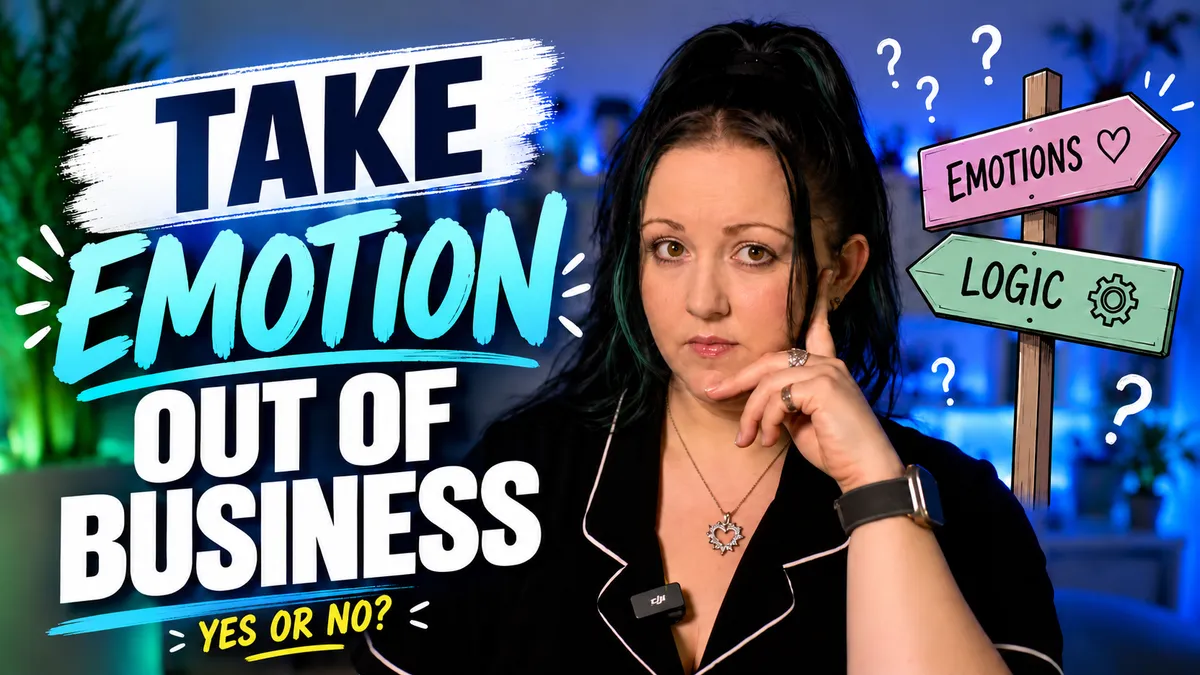
22. Stop Making Emotional Business Decisions - Is That Actually Good Advice?
Episode 22 | Stop Making Emotional Business Decisions - Is That Actually Good Advice?
| 27th October 2026 | 26 min



Watch the full episode on YouTube
💌 The Glow-Up Gazette: your weekly dose of inspiration and momentum. Plus our monthly prize draw. You in? → https://minddrophq.com/glowupgazette
Don't make emotional decisions. It's one of those pieces of advice that gets repeated so often in business and high-performance circles that we rarely stop to question it.
Be logical. Follow the numbers. Stay disciplined. Don't let how you feel interfere with what needs to be done.
And there's certainly value in that advice. Running a business requires consistency, clear thinking and the ability to make difficult decisions, even when they're uncomfortable.
But does that mean our emotions are something we should learn to ignore?
Not according to what we understand about the relationship between emotion and decision-making.
In this episode of Human Evolution, Jodi explores the neuroscience behind emotional processing and rational thought, including Antonio Damasio's influential somatic marker hypothesis and the role of the ventromedial prefrontal cortex in decision-making.
Using advice from Alex and Leila Hormozi as a starting point, she challenges the idea that emotion and logic are opposing forces.
Because while emotions can absolutely influence our judgement in unhelpful ways, they can also draw our attention to important information about our experiences, our environment and the choices we're facing.
The challenge is learning to recognise what we're feeling without automatically treating it as an instruction.
We also explore the relationship between high performance and emotional disconnection, including what happens when pushing through discomfort becomes our default response.
And through a conversation between Alex Hormozi and Tony Robbins about achievement, meaning and fulfilment, we examine a question that's particularly relevant to heart-led entrepreneurs:
What's the point of building an extraordinarily successful business if we're no longer connected to the life we wanted that business to create?
This isn't an argument against discipline, logic or making difficult decisions.
It's an invitation to reconsider what emotional strength actually looks like.
Because perhaps the answer isn't to become less emotional.
Perhaps it's to become more capable of working with our emotions while making thoughtful, evidence-informed decisions.
KEY TAKEAWAYS
Emotion and logic aren't opposing systems
Our brains don't make decisions through logic alone. Emotional processes, bodily signals, past experiences and cognitive evaluation can all contribute to how we assess options and make choices.
The somatic marker hypothesis proposes one explanation for how previous experiences and associated bodily signals may influence decision-making. While aspects of the hypothesis remain debated, broader research supports the view that emotion plays an important role in human judgement.
The question isn't whether emotions influence our decisions, but how we recognise and evaluate that influence.
Emotions are information, not instructions
Fear doesn't automatically mean you should avoid something. Frustration doesn't necessarily mean someone needs to be fired. And excitement doesn't guarantee an opportunity is worth pursuing. But these emotions may still be drawing your attention to something important. Learning to get curious about what you're feeling, rather than blindly following or dismissing it, creates more room for thoughtful decisions.
Intuition, emotion and learned responses aren't necessarily the same thing
Intuition can involve rapid judgements informed by patterns we've learned through experience. Sometimes those judgements are valuable. Other times, what feels like intuition may be influenced by fear, old conditioning or an incomplete understanding of the situation. The feeling itself doesn't necessarily tell us which one we're experiencing. That's why intuition, emotion and evidence all deserve careful consideration, rather than unquestioning trust or automatic dismissal.
Emotional regulation isn't emotional suppression
Regulation is about developing the flexibility and capacity to experience emotion, understand what's happening and choose how to respond. Suppression involves inhibiting emotional expression, which doesn't necessarily resolve the underlying experience. And importantly, being composed doesn't automatically mean someone is suppressing their emotions. We can be calm, strategic and consistent while remaining emotionally connected and aware. Being composed is not the same thing as being disconnected.
Discipline needs discernment
High performers are often incredibly capable of pushing through discomfort. But being capable of doing something doesn't automatically mean continuing to do it is the right decision. Recognising unsustainable workloads, persistent stress and the need for recovery is part of sustainable performance. Knowing when to keep going is a skill. Knowing when not to is one too.
Business success and personal fulfilment aren't the same measure
Revenue, profit and growth are important indicators of commercial success. But they can't tell us whether we're enjoying our work, feeling connected to others or building a life that reflects what matters to us. For entrepreneurs seeking FELT Freedom — financial, emotional, location and time freedom — success needs to be measured against more than financial performance alone. A thriving business and a fulfilling life don't have to be competing priorities.
The goal is integration, not emotional detachment
Good decision-making doesn't require blindly following every feeling. Nor does it mean disregarding emotional information entirely. It means developing the capacity to recognise what's happening, consider the evidence, examine what matters and choose how to respond. It's not an OR. It's an AND. You can be logical, strategic, disciplined and deeply connected to what you feel.
NOTABLE QUOTES
"There's a difference between allowing your emotions to dictate your decisions and allowing them to inform your decisions."
"Your emotions should get a seat at the table. They just shouldn't get to run the entire meeting."
"You don't have to disregard your emotions to make an intelligent decision, my friend. You don't have to follow them blindly either."
"Your emotions are not your enemy. Learning how to work with them might just make them one of your greatest allies."
CHAPTERS
00:00 The Spark
00:51 The Advice That's Going Around
03:32 The False Choice Between Logic & Emotion
06:27 Emotions Are Information, Not Instructions
11:55 When High Performance Becomes Disconnection
18:06 When Success & Fulfilment Aren't the Same Thing
23:14 Emotions Can Be Our Greatest Allies
25:45 Outro
Hey Gorgeous, Your Next Step Starts Here...
🧠 Free Nervous System Emergency Kit: a circuit breaker for the moment your nervous system feels overwhelmed or hijacked by survival mode. Emotional regulation tools
→ Grab your free kit: https://minddrophq.com/emergencykit
🌟 Inner Spark: the coaching membership that helps you build capacity, regulate and rewire, so your past stops dictating your future → Get Your Spark Back: https://minddrophq.com/innerspark
KEY REFERENCES
Bechara, A., & Damasio, A. R. (2005). The somatic marker hypothesis: A neural theory of economic decision. Games and Economic Behavior, 52(2), 336–372. https://doi.org/10.1016/j.geb.2004.06.010
Dunn, B. D., Dalgleish, T., & Lawrence, A. D. (2006). The somatic marker hypothesis: A critical evaluation. Neuroscience & Biobehavioral Reviews, 30(2), 239–271. https://doi.org/10.1016/j.neubiorev.2005.07.001
Gross, J. J. (1998a). Antecedent- and response-focused emotion regulation: Divergent consequences for experience, expression, and physiology. Journal of Personality and Social Psychology, 74(1), 224–237. https://doi.org/10.1037/0022-3514.74.1.224
Gross, J. J. (1998b). The emerging field of emotion regulation: An integrative review. Review of General Psychology, 2(3), 271–299. https://doi.org/10.1037/1089-2680.2.3.271
Gross, J. J., & John, O. P. (2003). Individual differences in two emotion regulation processes: Implications for affect, relationships, and well-being. Journal of Personality and Social Psychology, 85(2), 348–362. https://doi.org/10.1037/0022-3514.85.2.348
Hormozi, A. (Host). (2024, March 6). Why your feelings are killing your finances | Ep 662 [Audio podcast episode]. In The Game with Alex Hormozi. Acquisition.com. https://podcasts.apple.com/us/podcast/why-your-feelings-are-killing-your-finances-ep-662/id1254720112?i=1000648162452
Hormozi, A. (Host). (2026, January 21). How to find meaning when success feels empty with Tony Robbins | Ep 936 [Audio podcast episode]. In The Game with Alex Hormozi. Acquisition.com. https://podcasts.apple.com/us/podcast/how-to-find-meaning-when-success-feels-empty-with-tony/id1254720112?i=1000746025489
Lerner, J. S., Li, Y., Valdesolo, P., & Kassam, K. S. (2015). Emotion and decision making. Annual Review of Psychology, 66, 799–823. https://doi.org/10.1146/annurev-psych-010213-115043
World Health Organization. (2019, May 28). Burn-out an occupational phenomenon: International Classification of Diseases. https://www.who.int/news/item/28-05-2019/burn-out-an-occupational-phenomenon-international-classification-of-diseases
COMMON QUESTIONS
Should you avoid making emotional business decisions?
Not necessarily. Emotions can influence decisions in both helpful and unhelpful ways. Rather than removing emotions altogether, the aim is to recognise what you're feeling, consider why it might be happening and evaluate it alongside the available evidence before deciding how to act.
What does neuroscience say about emotion and rational decision-making?
Research indicates that emotion and cognition are interconnected. Brain regions involved in evaluating options and making decisions work with information from systems involved in emotional processing. The somatic marker hypothesis is one influential explanation for how bodily and emotional signals might contribute to decision-making, although aspects of it remain debated.
What's the difference between emotional regulation and suppression?
Emotional regulation involves processes that influence how emotions are experienced, expressed and responded to. Suppression is a particular regulation strategy that inhibits emotional expression. Someone can appear calm and composed without necessarily suppressing what they're feeling.
Is intuition the same as emotion?
Not exactly. Intuition often involves rapid judgements based on learned patterns and previous experience, while emotion involves broader psychological and physiological processes. The two can influence each other, and what feels like intuition can sometimes reflect fear, conditioning or a genuine recognition of something important.
Can ignoring emotions affect high performance?
Regularly overlooking emotional and physical signs of stress may make it harder to recognise when workloads or demands have become unsustainable. Prolonged workplace stress that isn't successfully managed can contribute to burnout. Sustainable performance requires both the ability to meet challenges and the capacity to recognise when recovery or change is needed.
Can you be successful in business without becoming emotionally detached?
Yes. Emotional detachment is not a universal requirement for business success. Leaders can make difficult decisions, maintain composure and remain disciplined while also recognising and considering their emotional experiences. Commercial success and emotional connection are not necessarily competing priorities.
What questions should I ask before making an important business decision?
Jodi suggests three questions:
What am I feeling?
What might that be telling me?
What does the evidence actually support?
These questions can help you consider your emotional experience alongside the facts, your values and what you're trying to achieve.
TRANSCRIPT
[00:00:00] The Spark
Are emotions really tanking your business? Because neuroscience suggests your emotions aren't your enemy. They may actually be a part of what makes good decision-making possible
[00:00:10] Intro
[00:00:51] The Advice That's Going Around
All right, so I wanna have a little fun with this episode today because there is a particular piece of advice that gets thrown around a lot in business and high performance circles. Don't make emotional decisions. Don't let your feelings get in the way.
Now I'm gonna talk about Alex and Leila Hormozi here as examples because they're two very influential voices in the business world, especially if you come from the funnels background as well, and they talk about this quite a lot. You'll see it on their reels and their socials. And before anyone gets their knickers in a knot, I actually really like these two, okay? I have followed them from the early days. We were both in the same sort of circles. Uh, I was just working on a brick-and-mortar whilst they were doing their gym thing, and I've learned a lot from them over the years. I have enormous respect for what they've built. But I also think that we should be able to question ideas, especially when we're sharing them on public forums, even when they come from people that we are inspired by and admire.
So this is not having a go at the Hormozis. Please understand that. It's about a much bigger conversation that's happening across the business and high-performance world, and one that I kinda wanna challenge a little bit.
In an episode of Alex's podcast, The Game, called Why Your Feelings Are Killing Your Finances, Alex talks about how successful CEOs become less emotionally reactive as their businesses grow. And at one point, he even says, "You basically, in some ways, have to become like a robot." Now, I, I understand what he's getting at. When you're running a business, especially one with employees and clients and significant responsibilities, you can't make important decisions based entirely on your emotional state of that day, depending on what your emotional state is of that day.
Your team needs consistency. Your clients need consistency as well. And sometimes you have to make decisions that feel a little uncomfortable. Leila also shared this advice of, "Don't make a permanent decision based on a temporary emotion." I actually agree with this. If you've had a terrible morning and a client sends you a really frustrating email, it's probably not the best time to fire your entire team, shut down your business, and move to a tropical island. Although, some days that tropical island does seem really nice.
Here's where I think the conversation-- I wanna open it up anyway. I wanna unpack it a little bit. There's a difference between allowing your emotions to dictate your decisions and allowing them to inform your decisions .
[00:03:32] The False Choice Between Logic & Emotion
Because we are so often presented with this choice. Are you being emotional or are you being logical? As though they are two completely separate things and you have to pick one. But that's not actually how our brains work.
All right, so let's get our little science-y hats on here for a second. Neuroscientist Antonio Damasio and his colleagues have done some really, really cool research exploring how emotions and bodily responses contribute to decision-making. One influential idea from this work is called somatic marker hypothesis. Now, stay with me here 'cause I swear it's not as boring as it might sound. But essentially, the hypothesis suggests that our brains use emotional and bodily signals shaped by previous experiences to help us evaluate different options. Now, think about how many decisions you make in a day. If your brain had to consciously analyze every single possible outcome, every risk, benefit, uh, every consequence from scratch, you would be there forever. We've touched on this in past episodes as well. Instead, past experiences and their emotional associations can help your brain identify what deserves attention, what might be risky, and what might be worth pursuing. It's not a perfect process. Those signals can be misleading, and the exact mechanisms proposed by the somatic marker hypothesis are still kinda debated. But we can actually see some of this playing out in areas of the brain involved in decision-making. One of the brain regions involved in integrating emotional-related information into decision-making is the ventromedial prefrontal cortex.
And if you've listened to the previous episodes of Human Evolution, you'll know that the prefrontal cortex, I refer to it as our CEO. That's the part of the brain that's involved with planning and evaluating options and making decisions, helping regulate our emotional responses, very important, all that executive functioning kind of stuff in there as well.
So our CEO isn't sitting upstairs in our building making decisions completely independently of our emotions. It's receiving and working with information from other parts of the brain, including areas involved in emotion, which means your thinking brain and your emotional processes aren't two separate departments competing for control. They're interconnected.
And research into emotion and decision-making shows that emotions can influence our choices in both helpful and unhelpful ways. So the question isn't really whether emotions should be involved in our decisions because, quite frankly, they already are. The question is whether we're recognizing and evaluating that emotional information or simply reacting to it. Because there is a big difference between feeling something and deciding you need to do something about it.
[00:06:27] Emotions Are Information, Not Instructions
And This is where I actually agree with something that Layla said. Feelings are not directives. I like 1000% agree with her on this. Just because you're scared doesn't mean you shouldn't do something, or because you're frustrated with a team member doesn't mean you should actually fire them. Or maybe you're incredibly excited about a new opportunity, it doesn't make it automatically a good investment. So I wanna add something to this conversation. Just because your emotions aren't instructions doesn't mean they're not information. Fear might be alerting you to some sort of, like a genuine risk. Frustration might be drawing your attention to something that isn't working and needs a, a rework or a redesign. Resentment might be pointing towards a boundary that you've repeatedly ignored, or maybe s- one that someone else keeps crossing, and excitement might be telling you that there's something worth exploring. Now, operative word here, important, is might, Because emotions aren't always an accurate reflection of what's happening in front of us. Sometimes we're responding to the situation itself. Other times, though, our nervous system is responding to something familiar from our past, and this is one of the reasons why I think working through our emotional past is just as important as the future-focused work that we do in coaching and personal development, and even therapy. Because we can spend all the time in the world setting goals, creating strategies, and deciding who we wanna become, but if we're still carrying old emotional responses that influence what feels safe, threatening, or possible for us, then those experiences can continue shaping the decisions that we're making today.
So I'm not suggesting that we need to revisit every major traumatic, difficult thing that's ever happened to us, although clearing some of that stuff out will probably help and benefit you. But where those old patterns are still influencing how you're showing up, there is value in working through them alongside building the skills and capacity we need to keep moving forward. Because those old responses and our reactions to what's happening right now can feel weirdly remarkably similar.
Take discomfort, for example. You might feel uncomfortable about a new business opportunity because it's unfamiliar. You're stretching beyond what you've done before, and you're worried maybe that you won't be able to pull it off. All valid. But you might also feel uncomfortable because you've picked up on something that's not sitting right. Maybe the expectations are unrealistic, or the person you're dealing with has been pushing your boundaries, or maybe the opportunity conflicts with something that you genuinely value. The feeling alone doesn't necessarily tell you which one it is.
And there's another part of this conversation as well that I can see popping up, which is intuition. Because intuition and emotion are not necessarily the same thing, even though we often talk about them as though they are and, and interchange them. Intuition is more of a rapid judgment based on information and patterns that we've learned to recognize, sometimes without consciously knowing how we've reached that conclusion. And I do wonder whether some of the business advice that we hear out there about ignoring emotions or not trusting your gut is actually referring to these instinctive judgments rather than emotions themselves.
Because sometimes our intuition is drawing on years of valuable experience. Other times, what feels like intuition might actually be fear or an old conditioned response, or maybe even a misunderstanding of the situation. And again, those can feel kind of similar. So we're not talking about blindly trusting every feeling or gut instinct. We're talking about learning to recognize what we're experiencing and evaluating it alongside the evidence, and also getting mighty, mighty curious about what's going on.
And I think that's part of why people like Alex and Layla place so much emphasis on not letting emotions dictate your decisions, because emotions can absolutely lead us astray, especially if we're not well-regulated in that process. But it's also why it's our job to get a little curious about what we're experiencing, rather than automatically treating the emotion as something to obey, get rid of, or worse, ignore completely, 'cause when does that often work?
This is where nervous system regulation comes in. Because when we're highly activated, overwhelmed, or feeling threatened, our attention can narrow, and our ability to think flexibly can become compromised. We can become more reactive, more focused on immediate relief, and less able to consider the bigger picture. But when we have the capacity to recognize what's happening, regulate our response, and stay engaged with the situation, we've got more room to examine what we're feeling alongside what's actually happening, like the factual evidence.
So is this discomfort telling me that there's a genuine problem? Is something familiar being triggered? is it actually relevant or important to what I'm doing right now? Am I trying to make this decision because it's the right one, or because I want an uncomfortable feeling to go away? Therein lies the distinction.
We're not giving our emotions the authority to make every decision, but we're not throwing away potentially valuable information either. Your emotions should get a seat at the table. They just shouldn't get to run the entire meeting.
[00:11:55] When High Performance Becomes Disconnection
And this brings me to the bigger conversation that I want us to have, because this isn't just about Alex and Leila Hormozi by any means. There are plenty of others that are talking about this as well. But it's something that we're seeing right across business and high-performance culture. Push through, hustle, stay disciplined, do the work regardless of how you feel. Don't let your emotions interfere with the mission.
And look, one could argue there's a little bit of value in that advice. Discipline and consistency are really important skills, especially in business, but also in, you know, like, life. And sometimes we absolutely need to do things that we don't always feel like doing.
I believe there's a point where we need to question what we're actually encouraging people to do here. Because there is a difference between developing the capacity to do difficult things and becoming so accustomed to overriding what you're feeling that you stop paying attention to it altogether. And I see this particularly with heart-led high performers or empathic entrepreneurs, if you resonate with that language more. Same, same really. These are the people who care deeply about what they do, have incredibly high standards, and are often the ones everyone else relies on. They're incredibly capable, resourceful, remarkably good at finding a way through things, even when they're running on empty and it doesn't look like it can be done. And because they're capable of doing it, they keep doing it, sometimes for years. And from the outside, that can look like incredibly disciplined, and it can look like resilience. But being able to push through discomfort doesn't automatically mean pushing through is the right decision.
And there's something I think we forget when we talk about emotions, especially in business, is that emotions aren't these abstract, weird feelings floating around in our heads. They're actually a very real biological process. Our senses are constantly picking up on information from the world around us, whilst our nervous system, our brain, and literally the nerves throughout our body are also monitoring what's happening inside our bodies at the same time.
So our brains are processing that information alongside our memories, previous experiences, and what we're anticipating might happen next. Hello, Forecaster. And all of this can contribute to what we experience emotionally. So when we talk about ignoring our emotions, we're not just simply dismissing some inconvenient feeling, which quite often is our subjective experience of that and the name that we actually give the emotion we could also be overlooking important information about ourselves and the environment that we are currently operating in.
And if we're regularly operating under prolonged stress without adequate recovery, our health can suffer. Our sleep, concentration, mood, physical wellbeing can all be affected. Over time, chronic workplace stress that isn't successfully managed can contribute to burnout. So this isn't just about whether you're feeling happy or sad when you make a decision.
We're also talking about the health and functioning of an actual human being. Sometimes resilience looks like following through on something difficult, but other times it looks like recognizing that something actually needs to change. And if we've trained ourselves to treat every uncomfortable emotion as an inconvenience to overcome or something to push aside or sweep under the rug, how do we tell the difference?
Well, for starters, in my mind, we need to stop treating emotional regulation and emotional suppression as though they're the same thing, because regulation isn't all about becoming emotionless or super calm. It's about having the flexibility and the capacity to experience an emotion, understand what's happening, and choose how we respond. We still stay connected to ourselves in that process.
Suppression is different. It involves inhibiting the expression of the emotion, and that doesn't necessarily resolve what we're experiencing internally.
Now, you know, I wanna be a little mindful around this because someone can be calm, composed, and consistent on the outside while still being fully aware with what they're feeling. That's not automatically suppression, and being able to maintain that kind of composure, especially when you're leading other people, can be a fantastic skill. We see it in emergency services, military personnel, crisis negotiators, elite athletes, and plenty of other high-pressure professions. Think of like surgeons and such. These are people who may need to remain composed and make good decisions in situations where their emotions are understandably running high.
But that doesn't mean the emotions aren't there or that they don't need to be acknowledged and managed. Being composed is not the same thing as being disconnected. And when emotional neutrality becomes the ideal that we're all trying to achieve, I can't help but wonder whether we risk confusing emotional strength with emotional disconnection, because there's a cost to constantly overriding your own internal feedback.
You might miss the early signs that your workload has become unsustainable. You might keep tolerating situations that aren't aligned with your values. You might become so focused on achieving that next goal that you rarely stop to consider whether the life you're building is one you actually enjoy living.
None of this means that discipline or emotion is bad. In my mind, it means that discipline needs discernment. Knowing when to keep going is a skill, but knowing when not to is one as well. And if you remember back to episode 17 when we explored the energy quadrant, we talked about the difference between the performance zone, survival zone, burnout zone, recovery zones. Because doing anything at a high level or high performance itself isn't about staying switched on all the time. You need recovery to sustain that level, and recognizing when your energy, emotions, and capacity are telling you it's time to recover is part of managing your performance, not a failure of discipline.
[00:18:06] When Success & Fulfillment Aren't The Same Thing.
And speaking of high performance, there's a conversation I came across recently that I really, really enjoyed watching for a bunch of reasons. Back in, I think it was January this year, Alex Hormozi sat down with Tony Robbins, hmm, my favorite combos, it's so great, for an interview about success, meaning, and fulfillment.
If you haven't heard it, I'd encourage you to check it out. I'll link it in the description and the show notes for you. Sometimes the video seems to be there and sometimes it disappears, but just keep checking in and hopefully you'll find it.
Anyway, because if we go back to Alex's earlier podcast episode where he talks about becoming almost robotic and less emotionally reactive to make better business decisions, this conversation with Tony sort of offers another beautiful perspective. At one point, Tony says to Alex, like, uh, "You get in your head, you're dead. Your heart is so big," or something along that line. And they get into this discussion about being in your head versus being connected to your heart. Now, Alex openly talks about how he doesn't really understand what Tony means by getting out of your head and into your heart, and not surprising at this point in time.
Like, everyone changes and evolves, okay? So this is not to say that what they've said in the past will stay that way or is gonna continue being their beliefs. And Tony challenges him on this, and it was such a beautiful interaction. So take it for what it is at the moment and allow the fact that people grow. So they also talked about, uh, achievement and contribution and emotional connection and what it actually means to feel fulfilled by the success you've created.
And there was something that Alex said that kinda caught my attention. He acknowledged that emotional connection was something that he'd struggled with, and I love the fact that he's so openly, transparent with this, especially publicly. I think it's a beautiful thing.
But at the same time, he also recognized that his analytical approach may have contributed to his extraordinary success in business, and I agree with that as well. I found that the contrast between the two things actually really interesting, because we're looking at two questions here.
What helps someone build an extraordinary successful business? And then what helps someone actually enjoy the life that they've built? I don't wanna suggest that Alex's approach was anything wrong, bad, or otherwise, because it's worked clearly quite well for him. Um, or that there's something missing from his life, because that's not for me to say. I don't know him personally. I can only share with what I can see online, that's been public. But I do think the conversation itself raises a really important question about how we define success. Because if the entire goal is commercial performance, then financial results become the primary measure of whether something's working. Numbers are fantastic at telling us certain things, especially in business. Revenue, profit, growth, efficiency, all important things to know. But they can't necessarily tell us everything. They can't tell us whether we're enjoying the work or whether our relationships are thriving or if we're feeling connected to the people around us and who we're serving in that process.
It doesn't help to show us whether the business that we've spent years building actually supports the kind of life we wanted in the first place.
And I think that's especially relevant to heart-led entrepreneurs and those seeking financial freedoms. Because for many of us, the whole reason we start a business was to create something meaningful, to have more freedom, and not just financial freedom. I'm talking about felt freedom, financial, emotional, location, and time freedoms. Like, to make a difference, to build a life that reflects what matters to us.
And somewhere along the way, it's possible to become so focused on making business successful that we stop checking whether it's actually delivering on those things. Now, to be fair, Tony wasn't suggesting that we should let emotions run the whole show either. He made a point that if you're unable to make a difficult decision within business, you know, because you're worried about either hurting their feelings or something like that, that can actually create serious problems within your business. And I'm on the same page there with him. Sometimes being a good leader means making decisions that are uncomfortable. But there's a difference between being able to make those decisions despite the discomfort and believing that emotional detachment is what makes you a good leader. And that's the point that's on my heart that I keep coming back to.
Perhaps the goal isn't to become less emotional as we become more successful. Perhaps it's to become more capable of working with our emotions while still making clear, thoughtful, and sometimes difficult decisions. Because whether we like it or not, emotional processing is happening all the time. It's a part of being human. It kinda comes with the territory. And I don't believe extraordinary performance and emotional connection need to be competing priorities. Actually, I believe quite the opposite. I think they can work in this beautiful synergistic tandem, especially when aligned with our values, emotional experiences, behaviors, and goals. And I certainly don't think we should have to choose between building a successful business and enjoying the life we're building alongside it at the same time.
[00:23:14] Emotions Can Be Our Greatest Allies
So are emotions really tanking your business? Well, they certainly can influence the decisions you make, sometimes for better, sometimes not. Instead of trying to take emotions out of business, what if we focused on developing the capacity to work with them? To recognize when we're responding to a genuine problem, when we're reacting to an old pattern, and when we're simply uncomfortable because we're doing something new. To be able to pause, look at the evidence, consider what we're feeling, get curious, and make a decision that aligns with our values and what we're actually trying to achieve.
Because emotional regulation isn't about feeling less, it's becoming integrated with ourselves. It's about having more choice in what we do with what we're feeling, and ideally, not blowing up your business, relationships, or life along the way.
And the next time you're facing a difficult business decision, I'd encourage you to ask yourself these three things: What am I feeling? What might that be telling me? And what does that evidence actually support?
And if you're recognizing that understanding your emotions is one thing, but actually working with them in real life is another, that's exactly why I created Inner Spark, and I would love to open that invite to you. Through the neuroregulation method, you'll learn to regulate your nervous system, clear those old emotional patterns, rewire new empowering responses, and build capacity to navigate whatever life throws your way, whether that's an unexpected curveball or a moment that calls for more than you've had to give before.
Because your emotions aren't the opposition, they're part of your team. And when you learn how to work with them and integrate them, rather than leaving them sitting on the bench, you've got another valuable player on the field, and you'll be so surprised with what you can do with it. The waitlist for Inner Spark is open for our January intake. So if you'd like to join us, you can find all the details at MindDropHQ.com/InnerSpark ..
You don't have to disregard your emotions to make an intelligent decision, my friend. You don't have to follow them blindly either, and it's not an or, it's an and
You can be logical, strategic, disciplined, and deeply connected to what you feel. Your emotions are not your enemy. Learning how to work with them might just make them one of your greatest allies.
I'll leave you with that one to think about. See you next week
[00:25:45] Outro
Explore: Nervous System Emergency Kit || Inner Spark || Sonic Success || Desire Rewire || The Glow Up Gazette