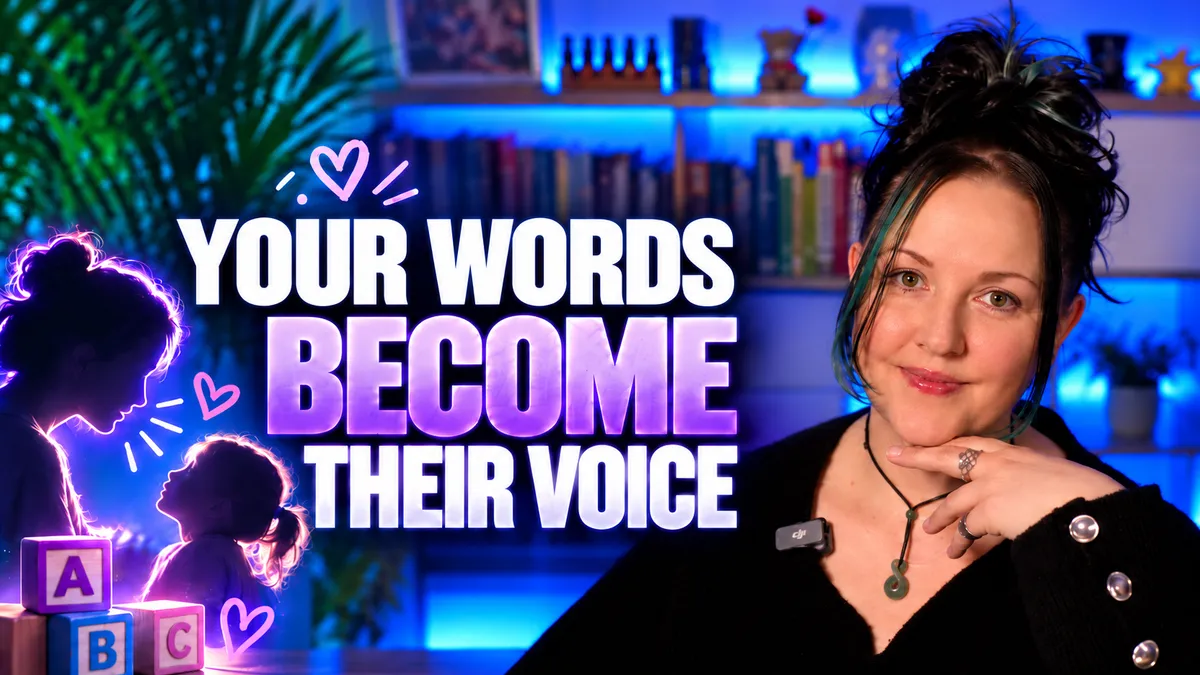
Episode 23 | The Words We Speak Into Our Kids



Watch the full episode on YouTube
💌 The Glow-Up Gazette: your weekly dose of inspiration and momentum. Plus our monthly prize draw. You in? → https://minddrophq.com/glowupgazette
“Your mummy has sacrificed so much for you.” It’s a sentence intended to express deep love and appreciation. But what might it mean to the child hearing it?
When we talk about the things we’ve given up for our children, we might be trying to communicate commitment. Yet for some children, repeated messages about sacrifice can raise a different question: am I responsible for what the adults in my life have lost?
In this episode of Human Evolution, Jodi explores the language we use around children and the unintended lessons it can carry. Drawing on her experiences as an only child, a step-parent to two boys, and someone who grew up in an emergency-services household, she reflects on how everyday messages about love, choice and danger can influence the way we see ourselves and the world.
The conversation begins with a social media post celebrating a mother and the sacrifices she has made for her child. Jodi examines the difference between genuine gratitude and a feeling of emotional debt, alongside research into parental conditional regard — a separate but relevant area of study concerning children’s experiences of approval and expectations.
Then we head to the playground, where familiar calls of “Be careful!” and “You’ll hurt yourself!” prompt another question: are we helping children assess a real risk, or communicating our own fear? Research on parental verbal threat information shows that children can acquire fears from the warnings adults give them, although it does not directly establish that ordinary playground cautions cause anxiety.
We also unpack longitudinal research on parent praise and children’s later motivational beliefs, and consider how acknowledging effort, strategies and problem-solving can help children recognise their capabilities.
This isn’t about blaming parents or suggesting one imperfect sentence determines a child’s future. It’s an invitation to become more aware of the messages we repeat — and the possibilities we open up when we make our language more intentional.
What if we could raise children who appreciate the love they receive without feeling indebted for it, and who understand safety without being afraid to explore?
KEY TAKEAWAYS
The meaning of sacrifice depends on the message a child receives
Parents may use “sacrifice” to express love, commitment and effort. But where sacrifice is communicated repeatedly as a loss for which the child is responsible, it may create a sense of emotional obligation. In the episode, Jodi uses the image of receiving an invoice for something you never ordered to explain why those words can feel so different to a child. One phrase does not determine a child’s beliefs. Context, tone, patterns over time and the wider relationship all matter.
Gratitude and indebtedness are not the same thing
A child can appreciate what a parent chooses to do without being made responsible for those choices. Parents can communicate effort, love, boundaries and the need for rest without suggesting that their child must repay them. Research into parental conditional regard addresses the emotional costs associated with approval linked to expectations; it is not a direct test of the word “sacrifice”.
Children can learn fear through adult language
A 2024 systematic review and meta-analysis by Nimphy and colleagues investigated how parental verbal threat information influences fear acquisition in children. Its findings support the wider point that adults’ words can affect what children perceive as threatening. They do not mean every warning is harmful: clear, proportionate information about real risks remains important.
The safety message can become part of a child’s worldview
Jodi reflects on growing up with a mom who worked first in policing and then as an ambulance officer. Learning to notice exits and watch her surroundings offered useful skills, but also contributed to her feeling on alert. She explores how learned expectations may draw attention to confirming evidence and gradually come to feel like the truth about the world.
Specific guidance can give children something they can use
“Have a look where you’re putting your foot next” offers a child a concrete action. A blanket “Be careful!” may not. During age-appropriate, supervised play, useful prompts can help children assess a situation and practise their own problem-solving rather than simply anticipating the worst.
Notice effort and strategies, not just outcomes
Gunderson and colleagues found that the kinds of praise parents used with toddlers predicted aspects of children’s motivational beliefs five years later. Acknowledging strategies, persistence and effort can help children recognise what they did and how they improved. The finding is predictive, not proof that any single type of praise guarantees later confidence.
We can change our language without demanding perfection
Jodi invites listeners to get curious about phrases that come out automatically, particularly when tired or worried. What are we actually hoping a child learns? Could we communicate the same love or concern in a way that supports their capacity, autonomy and sense of belonging?
NOTABLE QUOTES
“What if while you’re trying to show your kid how much you love them, they’re learning that they cost you your life? And while you’re trying to keep them safe, they’re learning to be afraid of living theirs...”
“What if we could teach that same gratitude without a child ever feeling like they have a debt to repay?”
“So what if instead of filling their heads with everything that might go wrong, we help them discover just how much they’re capable of getting right?”
“Let’s give them words that help them trust themselves rather than question their place in the world.”
CHAPTERS
00:00 The Spark
00:54 The Word That Stopped Me
05:58 The Meaning Behind the Words
08:36 Are We Teaching Safety or Fear?
13:50 Building Confidence Through Language
16:26 Something to Think About
19:59 Outro
Hey Gorgeous, Your Next Step Starts Here...
🧠 Free Nervous System Emergency Kit: a circuit breaker for the moment your nervous system feels overwhelmed or hijacked by survival mode. Emotional regulation tools
→ Grab your free kit: https://minddrophq.com/emergencykit
🌟 Inner Spark: the coaching membership that helps you build capacity, regulate and rewire, so your past stops dictating your future → Get Your Spark Back: https://minddrophq.com/innerspark
KEY REFERENCES
Assor, A., Roth, G., & Deci, E. L. (2004). The emotional costs of parents' conditional regard: A self-determination theory analysis. Journal of Personality, 72(1), 47–88. https://doi.org/10.1111/j.0022-3506.2004.00256.x
Gunderson, E. A., Gripshover, S. J., Romero, C., Dweck, C. S., Goldin-Meadow, S., & Levine, S. C. (2013). Parent praise to 1- to 3-year-olds predicts children's motivational frameworks 5 years later. Child Development, 84(5), 1526–1541. https://doi.org/10.1111/cdev.12064
Nimphy, C. A., Mitrou, V., Elzinga, B. M., Van der Does, W., & Aktar, E. (2024). The role of parental verbal threat information in children's fear acquisition: A systematic review and meta-analysis. Clinical Child and Family Psychology Review, 27(3), 714–731. https://doi.org/10.1007/s10567-024-00485-4
COMMON QUESTIONS
Can telling a child how much you sacrificed for them make them feel guilty?
It may, especially if the message is frequent, emotionally charged or suggests that the child is responsible for the parent’s losses. Other children may hear genuine love or gratitude. A single sentence does not establish harm; the meaning, context and repeated patterns are more informative.
Is saying “be careful” bad for children?
No. Warnings can be appropriate and necessary when there is genuine risk. The episode encourages parents to consider whether a warning provides useful information. A specific instruction, such as “check your footing”, may help a child respond to the situation more confidently.
What is parental conditional regard?
Parental conditional regard occurs when children experience approval or affection as dependent on satisfying certain parental expectations. Research has associated it with greater internal pressure and other emotional costs. It is distinct from a parent simply discussing their work or responsibilities.
Can children learn fear from their parents’ words?
Yes. Research summarised by Nimphy and colleagues shows that verbal information from parents about threats can influence children’s fear responses to unfamiliar things. The studies do not demonstrate that every everyday safety reminder produces fear or long-term anxiety.
What kind of praise helps children build confidence?
Praise that recognises effort, strategies and specific actions can reinforce a focus on learning. For instance, “You worked out where to put your feet and found your balance” identifies a skill the child used. Gunderson and colleagues found that early process-focused praise predicted later motivational beliefs.
How can parents help children develop self-efficacy?
Give children age-appropriate opportunities to make choices, solve problems and try manageable challenges with appropriate support. Rather than rescuing them from every difficulty, help them notice the skills they used to find their way through.
How can I change language I learned from my own parents?
Start by noticing the phrases you use automatically, especially under stress. Ask yourself what you want your child to learn, and whether there is a more useful way to express the same concern. Small, repeatable adjustments are more realistic than trying to speak perfectly every time.
TRANSCRIPT
[00:00:00] The Spark
What if while you're trying to show your kid how much you love them, they're learning that they cost you your life? And while you're trying to keep them safe, they're learning to be afraid of living theirs...
[00:00:14] Intro
[00:00:54] The Word That Stoped Me
Welcome back, my friend. So I came across this really beautiful [00:01:00] post on social media the other day. It was of a family celebrating one another, a very influential, personal training family online, and it's about a husband recognizing what an incredible mom his partner is, and just a whole lot of love and appreciation for one another.
And it was really sweet to read, But there was this one word that really caught my attention, and that word being sacrifice.
And here's what that post said: "This afternoon as he helped me massage our son and guide him through his breathwork before bed." By the way, like I totally adore that. I think that's so awesome. Um, anyway, it goes on to say, "He quietly reminded our son of everything I do for him. 'Your mommy has sacrificed so much for you. She's given her whole life to loving and raising you.' And in that moment, I was reminded of just how lucky I am to have a man who sees and appreciates all the things that often go unseen."
And it's heartwarming, and it's [00:02:00] beautiful, and I completely understand the, the gorgeous intention that's behind that.
It's a partner recognizing and appreciating the woman he loves and the mother of his child, and she's sharing her own appreciation for a husband who sees and values everything that she does.
That is incredible. It's so lovely to see that kind of support and appreciation between parents. But I kinda got stuck on the word sacrifice. It was like a pebble in my shoe. The whole message was just gorgeous, but I couldn't quite move past that one little thing. Because I remember hearing something kinda similar growing up, and I don't know whether you can resonate with this or not, but you might be able to.
So my mom would often talk and say things, um, about how much she'd sacrificed for me, but it was usually in the heat of the moment kinda situation, and when she wasn't feeling on top of the world, if you could imagine.
And I remember thinking even back then, and I was a kid, but I was like, "Hang on a minute," like I didn't choose to be born. [00:03:00] I didn't make those decisions. I didn't choose to be a parent, so why am I somehow responsible for what you've given up? And I used to feel that way because it was like there was a lot of guilt coming onto me.
There was a lot of, "Hey, I've sacrificed everything for you." And it wasn't from a place of necessarily, uh, appreciation or gratitude. It was coming from a place of lack and scarcity.
And having been a stepparent to two boys for many years, I have an understanding of the time and energy and financial commitments and responsibilities that come with raising kids. I don't, however, necessarily see those things as sacrifices, and maybe that's where I'm a little bit different, because I see them as choices, choices we make because we love someone, because we wanna give them opportunities and support them and spend time with them and be a part of their lives.
Sure, like, that sometimes does mean that you're choosing one thing over another. We've not got infinite energy, and our focus is limited. It's a part of life. We do that all the time. [00:04:00] We make those types of decisions in all sorts of relationships. But the word sacrifice, like the actual language, for me, it carries a different meaning.
It suggests that something has been lost or given up. And when we tell a child that we've given up our lives for them, I can't help but wonder what they actually hear. How does that sink into their tiny little developing minds and understanding of love and relationships and their own place in the world?
Because imagine being handed an invoice for something that you never even purchased. You didn't order it. You weren't involved in the production or the decision-making of any of it, but somehow there's a bill with your name on it
I wonder if that's how some kids actually experience the language of the word sacrifice. Not necessarily consciously either. They might not even have the words to explain it, depending [00:05:00] on where they're at and in the development stage and how old they are and their, their ability of speech. But perhaps they can start feeling that they owe something. It's a deeper type of thing.
Maybe they become reluctant to ask for things, or they feel really guilty when mom or dad seem unhappy. What about if they start putting other people's needs ahead of their own because they've learned that having needs means somebody else has to go without, and they don't like that?
Like, that is the basis of people-pleasing right there. And I'm not suggesting that one sentence creates those patterns by any means. This was just something that kind of sparked in my mind when I was reading it and got me thinking about the broader topic at hand.
And I believe that recognizing what parents do can absolutely foster genuine appreciation and gratitude. But what if we could teach that same gratitude without a child ever feeling like they have a debt to repay?
[00:05:58] The Meaning Behind The Words
I came across some [00:06:00] interesting research around parental conditional regard, where children experience their parents' approval as something connected to meeting expectations. A study by Assor and colleagues found that this was associated with greater internal pressure, resentment, and poorer wellbeing within the child. And it makes me wonder, once again, there's lots of wondering happening here today, how much of that pressure can be communicated through the everyday language that we use with our kids. And we don't even mean it. We're not intentionally setting out to do this.
Because just imagine, though, how differently that original message could have been expressed if we were thinking about it and more conscious of it.
So instead of saying, "Your mommy has sacrificed so much for you. She's given her whole life to loving and raising you." I mean, it's a beautiful sentiment. I, I'm, I'm not knocking that . I get where they're coming from and the intent behind it. It's not malicious whatsoever.
But what about if we said something like, "Your mom or mommy absolutely adores you. [00:07:00] She loves being your mom and loves taking the time to look after you, and I really appreciate everything she does for our family."
We're still recognizing the love, commitment, and the effort that goes into parenting, which is, like, a huge task, daily and never-ending. But we're also celebrating what the parent is choosing to give rather than highlighting what they've had to give up.
And look, this doesn't mean parents need to pretend that they're never tired or frustrated or overwhelmed or be perfect, because that's just not the world that we live in. If you need a break, I would recommend you say so. If you're exhausted, you can absolutely communicate that to your kid. Now, they're gonna be at different levels, granted, but saying something like, "I'm feeling really tired today, so I'm gonna take some time to rest," that's a good thing. Children can learn to respect other people's needs and boundaries through communication like that without [00:08:00] feeling responsible for the circumstances that actually created them.
So what if the way that we spoke about our own choices also taught our kids that they're allowed to make choices for themselves without guilt? And what if we actually gave them more opportunities to practice that? Little everyday decisions where they get to choose for themselves rather than having everything decided for them automatically.
We're not just changing the wording here and the language, we're modeling personal responsibility, healthy boundaries, and the freedom to make decisions without holding somebody else accountable for them.
[00:08:36] Are We Teaching Safety Or Fear?
Now, whilst we're on this topic of language and, and what that can actually mean to little tiny minds, there's another type of language that I hear quite often, particularly when I'm out at the parks or the playgrounds with the kidlets, and it's parents saying things like, "Be careful, don't fall. Watch out, or you'll hurt yourself," or something along that line.
And sometimes I'm watching these really cool, tiny little humans, and they're climbing, and they're swinging, and they're [00:09:00] balancing, and they're having an absolute blast, and they're doing it really well. They're out there being little acrobatic monkeys and figuring it all out.
But then the adult starts warning them about everything on the planet that could possibly go wrong. Now, obviously, if a child is in danger, intervening might actually be necessary. But when they're exploring something that's reasonably safe, how often we're communicating our own fear rather than helping them develop confidence in their own abilities.
Think about, like, learning how to drive for a minute here. So, imagine you're behind the wheel for the first time, and some of you this might be a few, we're gonna say moons ago, not decades. And every time you approach an intersection, right, your instructor starts shouting at you, "Don't crash! Watch out! You're gonna hit something!" Like imagine that was your first experience of driving. How confident would you [00:10:00] feel in that moment if an instructor did that with you? Like, what do you think your nervous system and your body is gonna respond like, let alone what does your mind do in that moment?
Now imagine that that same instructor calmly said, which I'm more than sure that your instruction when you first started driving was more like, is like, "Ease off the accelerator, check your mirrors, and look where you want the car to go."
You're still learning about safety, but now you've got information you can actually use, and you're not creating a panicked nervous system in the process. So what if we approached our kids' exploration in the same way?
I was really curious to see if any research had been done in this area, and I found quite a few studies. One that stood out to me was a 2024 systematic review and meta-analysis by Cosima Anna Nimphy and her colleagues at Leiden University. So they looked at the research on how children acquire fear through the information that their parents give them about [00:11:00] unfamiliar things. Across 17 studies included in the meta-analysis, they found that parental verbal warnings about threats could significantly increase the children's fear responses towards those things. Now, they weren't specifically studying parents shouting, "Be careful!" at playgrounds, but their findings do demonstrate that children can learn what to fear through the language adults use around them, and this resonates with me a lot.
See, my mom was a police officer for 10 years before becoming an ambulance officer, so when growing up, you can imagine the kind of chats that we had around the dinner table, and I was exposed to a lot of conversations about safety and being aware of my surroundings. Things like sitting with your back towards a wall so you could see the exits and being aware of, of who was coming and going, even keeping your room tidy so you'd notice if someone had been in there or not.
And look, some of those things can be really useful, and indeed they did help me at different times in my life. Situational awareness can be [00:12:00] a very valuable skill. But I also grew up incredibly watchful and mindful and alert a lot of the time. Where other kids would be, like, out playing, and I'd be out there with them, but I wouldn't be lost in the game of whatever we were doing. I'd often be scanning my surroundings and noticing who was around and what was actually happening, and, you know, knowing my exit points and all that sort of stuff. , And I can't help but think how much of that vigilance was genuinely necessary.
How much of my childhood did I miss out on just being a kid? Because when you're repetitively taught to anticipate danger, you start viewing the world through a different lens. You become more attuned to potential threats, and every time you find something that matches what you've been taught to expect, it becomes another piece of the evidence that your view of the world is correct, and it becomes a form of what we call confirmation bias. Over time, that belief can become so familiar that it no longer feels like something you've learned. It actually starts feeling like your truth about how the [00:13:00] world works, and that truth then influences how you navigate your life.
Now, I know my mom was doing what she thought was, like, the best to protect me. She's an awesome mom, so please don't think of anything outside of that. We get along really well, and I'm very grateful for the relationship that we have and all of my experiences with her.
She'd seen things through her work that most people never encounter, and naturally, she wanted to protect me from it and keep me safe. But sometimes the fears that we carry over from our own experiences can become the lessons we pass down to our children, even when their circumstances are completely different.
So what if instead of teaching our kids to see the world through our own fears, we help them develop the confidence to assess it through their own experiences?
[00:13:50] Building Confidence Through Language
And this is where I get really excited because I believe we have a wonderful opportunity to do things differently. There's a longitudinal study by Gunderson and colleagues that followed [00:14:00] children from their toddler years right through to around the end of their formation years of seven or eight years old. They found the type of praise children received early in life was associated with how they approached learning and challenges years later. In particular, when parents praised effort, strategies, and actions, their children were more likely to develop beliefs that their abilities could improve through practice.
So imagine a child climbing across some playground equipment. Instead of shouting, "Be careful, you're gonna fall," what if we said, "Have a look at where you're putting your foot next," or, "Make sure you've got good grip before you move"? We're still helping them stay safe, but now we're giving them something practical that they can actually use to navigate the situation. And when they make it across, instead of saying something like, "Oh my goodness, you nearly fell. Did you see that?" We could say, "Look at that. You worked out where to put your feet and you found your balance." Now we're helping them recognize something about their own ability. We're teaching [00:15:00] them self-awareness. We are helping them with their problem-solving, their coordination, their capacity to work things out, and that's where self-efficacy comes in, which is the belief in your ability to handle challenges and influence is what happens next.
Kids don't need us to rescue them from every little mistake, even though we instinctively really wanna help them. We've got, like, so much, you know, experience, and we know these things, and we have all the wisdom and, and then we can see things that they can't see with their tiny little minds and brains yet. So we wanna jump in. We wanna protect them. But here's the thing, sometimes they're gonna slip or fall or have to try something a few times before they get it. That's part of the learning. We don't wanna rob them of those experiences.
Now, obviously, we are not talking about exposing kids to serious hazards here, all right? So age-appropriate challenges with appropriate supervision are important, but allowing children to [00:16:00] experience manageable difficulties with our support gives them opportunities to build confidence through their own experiences. It also helps to develop a safe and secure connection with a parent.
So what if instead of filling their heads with everything that might go wrong, we help them discover just how much they're capable of getting right? Imagine what they could begin to believe about themselves.
[00:16:26] Something To Think About
I truly believe most parents are doing the best they can with the tools and the experiences that they've got. And experience has taught me that so much of the language we use comes from what we heard growing up. Sometimes we don't even realize that we're repeating it. There is enormous value in becoming more conscious of what we're speaking into our children's lives.
And perhaps one of the most useful questions we can ask ourselves is, "Am I helping my kid feel capable, loved, and supported? [00:17:00] Or am I unintentionally handing them my own fear, guilt, or expectations?"
A child can grow up appreciating everything their parents have done without believing they owe them for it. They can learn to recognize danger while still feeling confident enough to explore. And when they encounter something difficult, what if their first thought isn't, "I can't do this," or, "Something might go wrong," but instead is more curious driven, "I wonder how I can figure this out."
How much more empowering is that to a child? A human at any age for that matter. It's a very different way to approach life.
And if you're listening to this thinking, "Oh my goodness, I have said all of those things to my child," please do not turn this into another reason to beat yourself up. We parents do this, like we beat ourselves up enough as adults and humans, and yet alone parenthood on top of that.
You're allowed to learn too. You didn't know what [00:18:00] you didn't know before. In fact, it's actually a really beautiful thing to model for your kids. An adult who's willing to reflect and learn and make changes. The world would be such a great place if a lot of our kids did that into their adulthood too. You see, ultimately, the language we use becomes part of the environment that our children grow up in.
And while no single sentence necessarily determines who a child becomes, although it can definitely impact them greatly, the messages they hear repeatedly can help shape what they come to believe about themselves and the world around them.
So as you go about your week this week, perhaps become a little more curious about the words that come out of your mouth automatically, particularly when you're tired, worried, frustrated, or trying to keep your child safe.
And when you catch yourself about to say something you've always said before, ask yourself, "What am I actually wanting my kid to learn here? And could [00:19:00] there be a different way to communicate it?" It's gonna take a little bit of effort and energy to start with, but you will get better and quicker at this, and it will not be as hard in the long run, and it will actually start to become more natural for you to change up your language.
Sometimes, like the smallest adjustment in how we speak can offer a child an entirely different way of seeing themselves and the world around them. Because our kids are gonna carry some of our words long with them after they've grown up, and you know this to be true because you do the same thing with words that your parents said to you. I guarantee it.
Wouldn't it be wonderful if the words that they carried, though, were the ones that reminded them of how loved and capable and resourceful they really are?
So my Jodo thought for today, the take home, if you will, is let's give them words that help them trust themselves rather than question their place in the world.
See you next week
[00:19:59] Outro
Explore: Nervous System Emergency Kit || Inner Spark || Sonic Success || Desire Rewire || The Glow Up Gazette