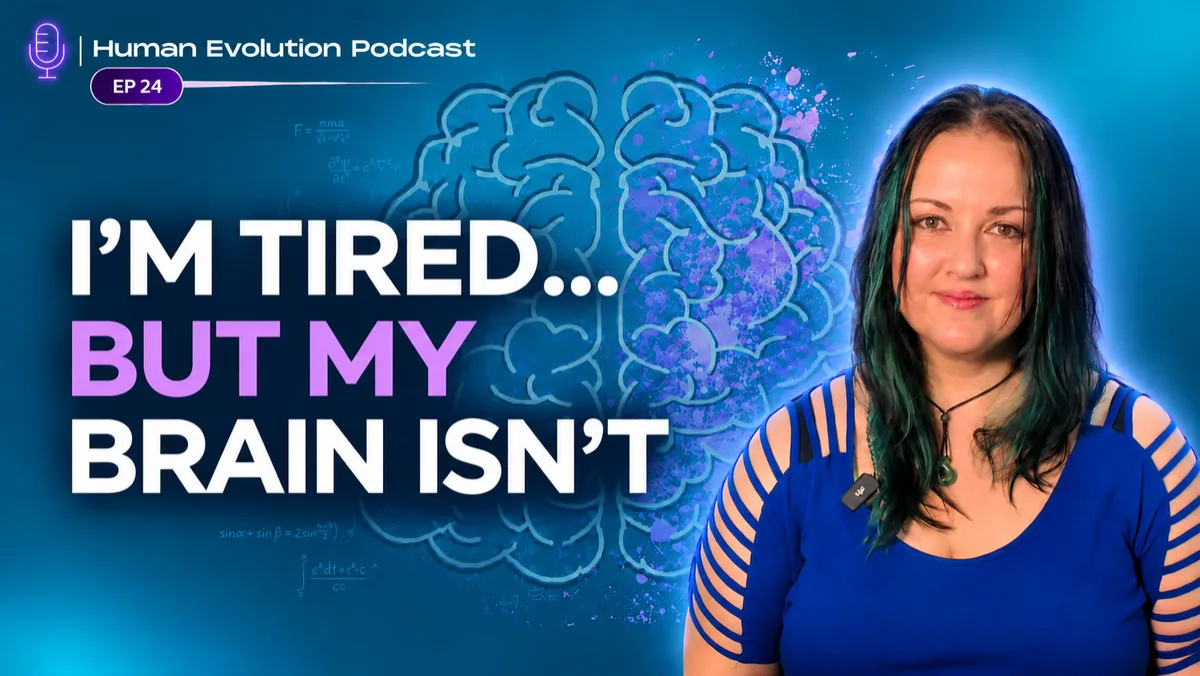
Episode 24 | Why You Can't Switch Your Brain Off at Night



Show Notes:
🌙 FREE COMPANION EFT TAPPING SESSION — DRIFT OFF
Struggling to switch your brain off at bedtime? I've created a free guided EFT tapping session to help ease racing thoughts, frustration and the pressure around falling asleep. → Listen to Drift Off: https://minddrophq.com/rocks
It's 2am. You're physically exhausted, but your brain won't switch off. You've tried the usual sleep advice, yet you're still lying awake, counting down the hours until your alarm goes off. In this episode of Human Evolution, Jodi explores why racing thoughts and the pressure to fall asleep can keep you awake, even when you're doing everything you're supposed to do. Drawing on research into cognitive arousal, sleep effort and insomnia, she shares practical strategies that go beyond sleep hygiene, including a five-minute writing exercise, stimulus control, EFT tapping and lavender aromatherapy. Plus, there's a free companion tapping session called Drift Off on Mind Drop Rocks to help ease the frustration and mental pressure around bedtime.
Key Takeaways
Being exhausted doesn't always mean your brain is ready for sleep
Cognitive arousal describes heightened mental activity, including worrying, planning and replaying conversations. For some people, this is accompanied by physiological alertness, creating that familiar experience of feeling tired but wired. When the distractions of the day disappear, those thoughts can become even more noticeable.
Trying harder to fall asleep can actually keep you awake
Sleep effort is the conscious attempt to make yourself fall asleep. Checking the clock, calculating how much sleep you're losing and worrying about how you'll function tomorrow can increase frustration and alertness. Research suggests that this pressure can become part of the cycle maintaining insomnia.
Different sleep struggles need different approaches
If unfinished responsibilities are occupying your mind, a five-minute bedtime to-do list may help. If you're feeling anxious or frustrated about being awake, shifting your focus towards reducing that emotional pressure may be more useful than trying to force sleep. EFT tapping is one option for exploring that emotional experience, while CBT-I offers established strategies such as stimulus control for persistent insomnia.
Your brain can learn new associations with bedtime
Repeatedly lying awake, frustrated and worrying can strengthen the association between bed and wakefulness. Stimulus control aims to rebuild the connection between bed and sleep. Familiar sensory cues, such as lavender aromatherapy, may also support relaxation, with human research identifying improvements in reported sleep quality and measurable physiological responses.
Notable Quotes
“But what if trying harder to fall asleep is actually part of what is keeping you awake?”
“And suddenly you're not just awake, you're worrying about being awake.”
“You can create the conditions that support sleep, but you can't simply command yourself to fall asleep.”
References
Broomfield, N. M., & Espie, C. A. (2005). Towards a valid, reliable measure of sleep effort. Journal of Sleep Research, 14(4), 401–407. https://doi.org/10.1111/j.1365-2869.2005.00481.x
Espie, C. A., Broomfield, N. M., MacMahon, K. M. A., Macphee, L. M., & Taylor, L. M. (2006). The attention–intention–effort pathway in the development of psychophysiologic insomnia: A theoretical review. Sleep Medicine Reviews, 10(4), 215–245. https://doi.org/10.1016/j.smrv.2006.03.002
Harada, H., Kashiwadani, H., Kanmura, Y., & Kuwaki, T. (2018). Linalool odor-induced anxiolytic effects in mice. Frontiers in Behavioral Neuroscience, 12, Article 241. https://doi.org/10.3389/fnbeh.2018.00241
Lillehei, A. S., Halcón, L. L., Savik, K., & Reis, R. (2015). Effect of inhaled lavender and sleep hygiene on self-reported sleep issues: A randomized controlled trial. The Journal of Alternative and Complementary Medicine, 21(7), 430–438. https://doi.org/10.1089/acm.2014.0327
Sayorwan, W., Siripornpanich, V., Piriyapunyaporn, T., Hongratanaworakit, T., Kotchabhakdi, N., & Ruangrungsi, N. (2012). The effects of lavender oil inhalation on emotional states, autonomic nervous system, and brain electrical activity. Journal of the Medical Association of Thailand, 95(4), 598–606. https://pubmed.ncbi.nlm.nih.gov/22612017/
Scullin, M. K., Krueger, M. L., Ballard, H. K., Pruett, N., & Bliwise, D. L. (2018). The effects of bedtime writing on difficulty falling asleep: A polysomnographic study comparing to-do lists and completed activity lists. Journal of Experimental Psychology: General, 147(1), 139–146. https://doi.org/10.1037/xge0000374
Stapleton, P., & van Elst, A. (2026). Clinical emotional freedom techniques for psychological and physiological stress reduction: A systematic review and network meta-analysis. Explore, 22(5), Article 103474. https://doi.org/10.1016/j.explore.2026.103474
Sweetman, A., Putland, S., Meaklim, H., Winter, S., Kennedy, G., Lack, L., Bartlett, D., Szeto, J., Blunden, S., Salles, H., White, V., Scott, A., Richardson, C., Grivell, N., Haycock, J., Sullivan, D. P., Oldenhof, E., Pickering, S., Junge, M., . . . Ree, M. (2026). Management of adult insomnia in Australia: A joint position statement of the Australasian Sleep Association, Sleep Health Foundation, Royal Australian College of General Practitioners, Australian Psychological Society, Pharmaceutical Society of Australia, and Australian Primary Health Care Nurses Association. Sleep Advances, 7(3), Article zpag086. https://doi.org/10.1093/sleepadvances/zpag086
Common Questions
Why can't I switch my brain off at night?
One possible explanation is cognitive arousal, where your mind remains busy with thoughts, worries, planning or replaying past events. The quiet of bedtime can make this activity more noticeable. Some people also experience physiological alertness, leaving them feeling exhausted but mentally wired. Persistent sleep difficulties can have other causes and may require assessment.
Why do I overthink everything when I try to sleep?
During the day, external demands compete for your attention. At bedtime, those distractions disappear, leaving more room for unfinished thoughts and worries. If you've repeatedly experienced frustration or anxiety in bed, those learned associations may also contribute to bedtime alertness.
Can trying too hard to sleep actually keep me awake?
Yes. Research into sleep effort suggests that consciously trying to force sleep can increase monitoring, frustration and arousal. Worrying about how little sleep you're getting may make falling asleep more difficult.
How can I stop racing thoughts before bed?
One practical option is to spend five minutes writing a specific to-do list for tomorrow. Research suggests this may help some people fall asleep faster. You can also experiment with reducing sleep-related pressure rather than trying to suppress every thought.
Should I get out of bed if I can't sleep?
If you're lying awake and becoming increasingly frustrated, getting out of bed for a quiet activity in dim lighting may help. This is part of stimulus control, an approach used within CBT-I to strengthen the association between bed and sleep.
Can EFT tapping help with sleep anxiety?
EFT tapping has been investigated for managing stress and anxiety, and some people may find it useful for addressing the emotional pressure surrounding sleeplessness. Jodi's free Drift Off session on Mind Drop Rocks provides a guided practice specifically for a busy mind at bedtime.
Does lavender aromatherapy really help with sleep?
Some human research has found improvements in self-reported sleep quality with lavender aromatherapy. Other studies have identified measurable physiological responses following inhalation, including changes in heart rate, blood pressure and brain electrical activity. The findings are promising for relaxation and sleep support, although lavender isn't an established treatment for chronic insomnia.
Can you train your brain to associate your bed with sleep?
Yes. Stimulus control, a component of CBT-I, uses behavioural strategies to help strengthen the association between bed and sleeping rather than wakefulness or frustration. There are other methods that can also achieve similar results.
When should I seek help for insomnia?
If sleep difficulties are persistent, affect your daytime functioning or regularly interfere with your quality of life, it's worth speaking with a GP or qualified sleep professional. CBT-I is recommended as a first-line treatment for chronic insomnia.
Chapters
00:00 The Spark
00:21 Intro
01:02 Let's Talk About Sleep
02:05 Why Your Brain Won't Switch Off
03:02 The Pressure to Sleep
04:12 So What Can You Actually Do?
06:17 One More Thing
08:55 The Mind Drop Rocks Project
10:20 Outro
Transcript
[00:00:00] The Spark
It's 2:00 AM, you're in bed, but you're wide awake. Your mind won't switch off even though you've done all the things they've told you to do. You're counting down the hours before you have to get up, and you're trying to will yourself back to sleep. But what if trying harder to fall asleep is actually part of what is keeping you awake?
[00:00:21] Intro
[00:01:02] Lets Talk About Sleep
All right. Let's talk about sleep, because if you've ever been absolutely exhausted, dragged yourself into bed, and suddenly found your brain running through tomorrow's to-do list, a conversation from three days ago, or that embarrassing thing you said in 2017, you're going to know exactly what I'm talking about.
And you've probably tried all the usual advice, less screen time, no caffeine after lunch, a warm bath, magnesium, herbal tea, a bedtime routine that practically requires its own instruction manual. Some of those things can genuinely help, and creating supportive sleep habits is never a bad thing. But if you're doing all of that and still finding yourself staring at the ceiling, there's a reason those strategies might not be enough.
In fact, in July 2026, a group of Australia's leading sleep and healthcare organizations released a joint position statement confirming that sleep hygiene alone isn't an adequate treatment for chronic insomnia. That is pretty significant considering how often we're told that better sleep is just a matter of better habits.
[00:02:05] Why Your Brain Won't Switch Off
There's a concept in sleep science called cognitive arousal. Essentially, it's heightened mental activity, which is like worrying, planning, analyzing, mentally rehearsing conversations, or anticipating what might actually happen tomorrow.
Your body is exhausted and needs rest, but your mind is still incredibly busy.
And during the day, you've got plenty of things competing for your attention, work, people, family responsibilities, conversations happening, and then bedtime comes. The distractions disappear, and suddenly you've got an uninterrupted opportunity to think about absolutely everything.
And for some people, this mental activity is accompanied by a physiological arousal as well. So it might have an elevated sense of alertness or tension that you can feel or that feeling of being tired but totally wired. And sleep becomes much harder when you're maintaining that level of alertness.
[00:03:02] The Pressure To Sleep
Think about what happens when you realize you're still awake. You check the clock, it's 11:30. You've gotta get up at 6:00. You start calculating how many hours you've got left to sleep. Then it's midnight, then it's 12:30, and suddenly you're not just awake, you're worrying about being awake. "I'm gonna be exhausted tomorrow. I've got so much to do. Why can I not just fall asleep? I just wanna go to sleep, go to sleep."
And the harder you try, the more frustrated you become, and the quicker you see that clock count down. There's a concept in insomnia research called sleep effort, and it's the conscious attempt to make yourself sleep.
And unfortunately, sleep doesn't respond particularly well to being chased. You can create the conditions that support sleep, but you can't simply command yourself to fall asleep.
And for people experiencing loss of sleep or in particular insomnia, that pressure can become part of the cycle maintaining it.
So over time, your brain can even start associating getting into bed with alertness, frustration, and worry.
Now, this is quite different from the association we actually want, which is bed as somewhere to relax and sleep
[00:04:12] So What Can You Actually Do?
So I wanna give you a couple things you can experiment with tonight, depending on what's happening for you. First up is if your mind is occupied with everything you've gotta do tomorrow, and you have those racing thoughts around about, like, the never-ending to-do list, give those thoughts somewhere to go.
There's a small but really interesting study from Baylor University where researchers had participants spend five minutes writing either a list of completed activities or a to-do list right before bed.
The people writing their future to-do lists fell asleep faster on average, particularly when those lists were more specific. So rather than lying there mentally trying to hold on to everything, grab a pen and write it down. What needs doing? What's the next action? What can wait? Those kind of things.
You're giving yourself a place to return to those responsibilities tomorrow instead of continually rehearsing them through the night. The second thing is for those moments when you're getting increasingly frustrated because you're still awake, and this is where I would like for you to change your objective.
So instead of making your immediate goal, like, "I have to fall asleep," I'd like for you to try making it, "I wanna reduce some of the pressure I'm feeling about being awake." That might involve noticing the tension in your body, slowing down, or using a regulation practice. One of the approaches that I really love and I use in my coaching with my clients is EFT tapping.
It's a technique that combines acknowledging what you're experiencing, often the negative, which I know sounds weird 'cause it's... We're, we're taught not to focus on the negative, but in this respect, it works really, really well. And then we're tapping on specific points of the body at the same time.
There's research exploring its effects on stress and anxiety, although we don't have sufficient evidence to treat it as a replacement for established insomnia treatments. It's definitely something you can try out and see if it can help for you.
For the purpose of this podcast topic, we're simply using EFT tapping as a way to explore whether we can ease some of that frustration and the mental pressure.
[00:06:17] One More Thing
Okay, so there's one more thing I'd love to share with you as well before we go. There's an approach using cognitive behavioral therapy for insomnia, or what they call CBT-I. So if you're lying in bed unable to sleep, sometimes the best thing you can do is actually get out of it.
I know it sounds a little backwards, right? Almost kind of counterintuitive, but I literally mean, like, get out of bed. But think about it this way. If you're spending night after night laying in bed frustrated, checking the clock, worrying about tomorrow, and trying to desperately fall asleep, what are you actually teaching your brain to associate with being in bed?
Potentially frustration, worry, being wide awake, and that's ideally the association that we would like to change. So it's called stimulus control, and the idea is that if you're lying there wide awake and getting frustrated, you get up out of bed, And you go do something that's quiet in dim yellow to warm light, okay?
We do not want any of those blue lights happening. And head back to bed when you're feeling sleepy.
We're essentially helping your brain relearn that bed is somewhere that you sleep rather than somewhere that you spend hours stressing about not sleeping.
You can also experiment with aromatherapy to help create that association as well. And lavender is particularly interesting because its benefits aren't necessarily just about enjoying, like, a nice kind of smell. Research out of the University of Minnesota in the US and Chulalongkorn University in Thailand have found that lavender aromatherapy can improve sleep quality and produce measurable physiological changes, including reduction in heart rate and blood pressure, as well as changes in brainwave activity associated with relaxation.
Lavender also contains naturally occurring compounds like linalool, which preclinical neuroscience research suggests may influence brain signaling involved in anxiety and relaxation.
So we're not just talking about nice smelly stuff here. There are potential physiological mechanisms at play alongside the opportunity to create a familiar sensory cue or what you might know as an anchor or conditioned response that your brain associates with winding down.
Which is why something as simple as introducing a gentle, unadulterated lavender essential oil into a diffuser into your evening routine might be worth trying. Rather than expecting it to knock you out, you're supporting relaxation while building a consistent association with bedtime and sleep.
Of course, if this sleeplessness is something you're experiencing on the regular, especially over months, it is worth chatting to your GP or a sleep professional about as well, because there are health, psychological, or medical conditions that can interfere with sleep that might be worth checking out.
[00:08:55] The Mind Drop Rocks Project
So tonight, if you find yourself lying there with your brain whirring 100 miles an hour, rather than getting frustrated with yourself, get curious about what actually is keeping you awake.
And to help with that busy mind, I've created a companion EFT tapping session called Drift Off over at Mind Drop Rocks.
If you haven't heard me talk about Mind Drop Rocks before, it is my pro bono project where I paint gratitude rocks, and I leave them out in the world for people to find. It's just a small way to spread a little bit of kindness and encouragement and gratitude and create moments of connection. And now I'm expanding that project with its own podcast as well, which is offering free guided EFT tapping and neuro rewiring meditation sessions to support people through everyday challenges.
There's no cost, there's no signups or opt-ins. It's just a few resources available for when you need them.
I've had the most beautiful people help me in different areas of my life over the years, which I am so grateful for, and this is my way of paying it forward and contributing to other fellow amazing humans that might need a helping hand as well.
So the drift-off session is designed to help ease some of that mental activity and the pressure that comes along with trying to fall asleep.
You can listen to it just before bed, tap along, and see how you feel. You can check it out at minddrophq.com/rocks. I'll also, pop it into the show notes so you can find it easily.
So here's to a good night's sleep, a quieter mind, and some awesome dreams,
[00:10:20] Outro
Follow Mind Drop
Instagram: https://instagram.com/minddrophq
Facebook: https://facebook.com/minddrophq
YouTube: https://www.youtube.com/@minddrophq
Explore: The Glow Up Gazette || Nervous System Emergency Kit || Inner Spark || Sonic Success || Desire Rewire