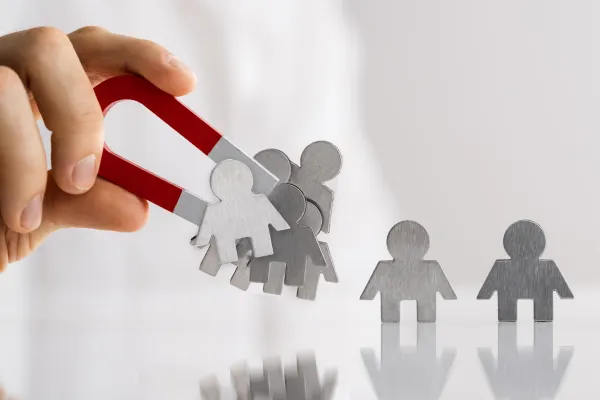
09. Why You Attract the Same People - Even When You Swore You Wouldn't
Episode 9 | Why You Attract the Same People - Even When You Swore You Wouldn't | 28th July 2026 | 45 min




Watch the full episode on YouTube
💌 The Glow-Up Gazette: mindset and wellness tips that actually shift things, plus our monthly Glow Getter prize draw. You in? → Subscribe Here
You left the last one for good reason. You found someone new. And somehow, nothing feels any different...
Here's the reframe this episode runs on: you're not attracting the same people, you're recognising them. Your nervous system scans everyone you meet against a blueprint laid down long ago, and the ones who match feel like a spark, because familiar reads as safe, whether or not it ever was. That's why the wrong one can feel like home and the steady one can feel like nothing at all.
But recognition only explains who you're drawn to. It doesn't explain why the same dynamic reassembles itself even when you pick someone completely different, or why it shows up at work with people you never chose. We get into the second thing running underneath all of it, the part that actually changes how you shift this, and the line the whole episode holds onto: your nervous system recognising someone does not make you responsible for what they chose to do.
KEY TAKEAWAYS
Attraction is often recognition in disguise.
The spark you feel when you meet someone is often recognition, not compatibility. Your nervous system scans new people against patterns it already knows, and because familiar things are easier for the brain to process, it reads that ease as safety. So someone who matches an old blueprint can feel like home before they've done a single thing to earn it. What you're calling chemistry is often just familiarity, dressed up.
The safe one feeling "boring" is data, not truth.
Feeling no spark with a kind, available person usually says more about your wiring than about them. If the closeness you knew growing up came tangled up with fear, or unpredictability, or having to earn it, your nervous system can wire safe together with flat, and uneasy together with exciting. So the steady person reads as nothing, not because they're wrong, but because there's no familiar pattern there to recognise.
You carry the pattern, not just the person.
The same relationship dynamic can repeat even when you choose a completely different person, because you bring the automatic pattern with you. The old response runs quietly in the background and shapes the space between you. It shows up at work too, with colleagues you never chose and never felt a spark for, and that's the proof: when you strip out the choosing entirely and the same dynamic still forms, it was never only about who you pick.
It changes through experience, not insight.
Understanding a pattern doesn't stop it, because insight and the pattern are stored in different parts of the brain. You can explain exactly why you do something and still do it at full speed. What actually rewires it is repeated lived experience that contradicts the old prediction, felt in the body over time, until the new response has enough road under it to run on its own. Staring at an X-ray doesn't set the bone.
NOTABLE QUOTES
"Recognition is not consent. Familiarity is not permission."
"Safe, to a nervous system that was never shown safe, can feel more dangerous than the danger it already knows."
"The spark was never the evidence. It was just the recognition, and you get to decide what you do with that now."
TIMESTAMPS
00:00 The Spark
00:22 Intro
01:02 Attract or Recognise?
08:04 Your Blueprint
14:40 How to Catch It
16:56 The Unfamiliar Is a Question Mark
18:59 Where Else This Pattern Turns Up
23:18 The Second Engine: The Dynamic
27:41 Where Else This Plays Out
31:29 Your Highway
37:35 How to Change It
41:40 Wrapping Up
43:47 Coming Up Next
45:00 Outro
PS: Want to build the new road? Here's where we do that together.
🌟 Inner Spark: If this episode named something you've been carrying for years, the next step isn't understanding it better, it's giving your nervous system the new experiences that actually rewire it. Inside Inner Spark, The Capacity Lab (our signature self-paced course) walks you through the framework, and the Guided Practice Lab is where the live coaching, clearing and rewiring happen. It's the Neuro-Regulation Method, applied.
→ Join Inner Spark: https://minddrophq.com/innerspark
Stuck in survival mode? The Nervous System Emergency Kit gives you practical tools to regulate in the moment, with a 30 day free trial of Inner Spark inside to help you build real capacity.
→ Grab the $5 kit: https://minddrophq.com/emergencykit
KEY REFERENCES
Baylin, J., & Hughes, D. A. (2016). The neurobiology of attachment-focused therapy: Enhancing connection and trust in the treatment of children and adolescents. W. W. Norton.
Kuhn, M. H. (1950). HEBB, D. O. Organization of Behavior: A Neuropsychological Theory. Pp. xix, 335. New York: John Wiley & Sons, 1949. The Annals of the American Academy of Political and Social Science, 271(1), 216–217. https://doi.org/10.1177/000271625027100159
Siegel, D. J. (2015). The developing mind : how relationships and the brain interact to shape who we are (2nd edition.). The Guilford Press.
Teicher, M. H., Samson, J. A., Anderson, C. M., & Ohashi, K. (2016). The effects of childhood maltreatment on brain structure, function and connectivity. Nature Reviews. Neuroscience, 17(10), 652–666. https://doi.org/10.1038/nrn.2016.111
Wiesenfeld, H. (1980). Kohut, Heinz . The Analysis of the Self; a Systematic Approach to the Psychoanalytic Treatment of Narcissistic Personality Disorders , 1971. The Restoration of the Self , 1977. The Search for the Self, 2 vols. , 1978. All published by International Universities Press, New York. The San Francisco Jung Institute Library Journal, 1(3), 1–23. https://doi.org/10.1525/jung.1.1980.1.3.1
Zajonc, R. B. (1968). Attitudinal effects of mere exposure. Journal of Personality and Social Psychology, 9(2, Pt. 2), 1–27. https://doi.org/10.1037/h0025848
COMING UP NEXT
Next week: you find the safe one. Things are finally going well, steady, good, everything you said you wanted. And then, right when you're closest to the thing you've been working toward, something in you goes looking for a reason to wreck it. That's not you being self-destructive for no reason. There's a mechanism under that too, and it fires hardest right before a breakthrough. Episode 10, why you self-sabotage right before the breakthrough. See you there.
COMMON QUESTIONS
Why do I keep attracting the same type of person?
You're most likely recognising them, not attracting them. Your nervous system scans everyone you meet against a blueprint built from earlier experiences, and the people who match feel familiar, which the brain reads as safe. That familiarity feels like a spark or chemistry, even when the pattern being matched wasn't good for you.
Why do I feel no spark with someone who's genuinely good for me?
Because there's nothing familiar for your nervous system to recognise. If safety wasn't what you grew up around, a calm, consistent, available person can register as flat or boring rather than exciting. The absence of a spark isn't proof they're wrong for you. It's often a sign your nervous system simply has no stored pattern that matches them.
Is it my fault that I keep ending up in the same relationships?
Yes and No. The patterns driving who feels familiar were laid down early, often by an environment you didn't choose and couldn't have controlled. Your nervous system recognising someone does not make you responsible for how they chose to treat you. However, you are responsible for your part in the relationship. Good news though, what is yours now, if you choose it, is the work of slowly building a new pattern.
Why does the same dynamic show up even when I pick someone different?
Because the pattern travels with you. Beyond who you're drawn to, there's an automatic response, deferring, going quiet, managing the other person, (or whatever your typical reaction may be) that runs on its own and shapes the relationship from the inside. It shows up at work and in friendships too, with people you never chose, which is how you know it isn't only about selection.
How do you actually stop repeating relationship patterns?
Not through understanding alone. Because the pattern lives in the body rather than in conscious thought, it changes through repeated real experiences that contradict what your nervous system expects, holding a boundary and not being abandoned, showing a need and being met with care. Over time, and often with support, those new experiences build a new default.
TRANSCRIPT
[00:00:00] The Spark
You left the last one for a good reason. You were brave enough to start again, and you found someone new, and nothing, nothing feels any different. Same pattern, same place you swore you'd never be again. Somehow you've attracted the same person all over again. And is it ever gonna change?
[00:00:22] Intro
[00:01:02] Attract or Recognise?
So I wanna start today's episode with the word in the title, attract. It's a word that gets thrown around a lot in this space, and it carries this assumption that there's something coming off of you, some sort of signal or some energy or some sort of frequency that you're putting out there that pulls a certain kind of person towards you.
And the fix that comes bundled with this when you're attracting the wrong type of person, it usually sounds something like this. It's like, "Raise your energy. Lift your vibration. Become the higher version of yourself or the highest version of yourself, and the ones who don't match that anymore will just fall off.
They'll fall away. They won't be able to sit in your presence. They'll feel that shift and quietly disappear." Now, I really wanna pull this apart because I think there's some merit to this, but I actually think it's mostly [00:02:00] backwards. And the version that I see that I feel is actually what's happening is a little bit more useful to know.
So let's take the disappearing part first, okay? Because I've watched this one not go the way that people are promised, like time and time again. You do the work, you become more regulated, more grounded, more sorted. And instead of the takers or these people that you're not really wanting to attract, backing away, have you ever felt that some of them actually lock on harder? Like they don't leave, they actually lean in.
And there's a reason for that. And it kind of has a little bit to do with energy and vibration, uh, in the sense of think of what you're giving off when you're doing really well, okay? So you're warm, and you're capable, and you are able to hold this beautiful space. You make people around you feel really grounded and really steady, [00:03:00] and those are genuinely really amazing qualities that people love to be around.
They're also exactly what a certain kind of person is actually scanning for themselves. So think about it as the person you don't want to attract, that you seem to always attract. They then are looking for someone to over-function for them, for someone to absorb their stuff and keep them regulated so they never have to do it themselves. And we're not talking about like a co-regulation. We're talking almost like a codependence.
So the brighter that you get, the more you look like precisely what they're looking for. It's like a moth to a flame. So the idea that leveling up makes them scatter and disappear isn't just a bit optimistic. Sometimes it actually does the complete opposite. You end up attracting more of what you don't want than what you do want. And I wanted to [00:04:00] unpack that because there's a lot of people who do the work, and then because this is happening, they feel like they've done it wrong or there's something wrong with them and they can't manifest things, the manifestation doesn't work, et cetera, et cetera.
It doesn't actually mean that. What it means is that the thing that draws them was never a low vibration in the first place.
So this brings me back to the other part of it, all right? The idea that you're the one sending out that signal that pulls them in. So here's some framing you've probably already heard of because it's pretty much everywhere right now.
You've seen it in a reel or maybe more than one. And the claim goes something a little like, you unconsciously seek out the same pattern or the same dynamic, like painful dynamic again and again and again because some part of you is wanting to heal it. So there's this other side of it. It's like, hey, you have to repeat this until you heal it. Like, we're gonna-- the universe is gonna continue giving you the lesson until you figure it out and deal with it.[00:05:00]
There's a part of that that I agree with to an extent. So the patterns that stay out of sight keep running. When something finally does surface, when you can actually see, like, the shape of that thing, and what you keep doing, that's what gives you actually a real shot at changing it.
Now, I felt that myself. I've gone through this many times over my lifetime. The moment that a pattern stops being invisible and starts being something you can name and put a structure to is actually a real turning point, and I don't wanna take that away from anybody, okay? But there's a second half to this framing, and this is where I sort of decide to walk a different path because the pop psych spin can often come across like you're going back for it. Like it's your fault that it exists, and that some part of you, even unconsciously, is choosing this pain. It's seeking it out. It's, it's authoring the whole thing up just so [00:06:00] you can resolve this wound. How very Freudian.
And when you sit that idea next to a real experience, and what I mean by that is next to someone who is actually being targeted, someone who's been harmed by another person's choices, someone who, you know, this other person was malicious or narcissistic or just some form of not healthy human, it starts to sound a lot like that this was actually on you and like it was your fault.
Like you called it in. Like if you'd done your inner work properly, they wouldn't have been able to do what they did. And that's the part that I am not okay with. I'm not sold on that
And I wanna be really clear here because what I say next is kind of the ground of what this episode stands on, okay? Your nervous system recognizing someone does not make you responsible for what they chose to do. The person who crossed the line made that decision. Recognition is [00:07:00] not consent. Familiarity is not permission. Whatever your body recognized when you met them, it didn't hand anyone the right to treat you the way they did.
And here's the thing, so there's two sides to a coin here, okay? You didn't necessarily install this pattern. It was created within you early on by conditions you didn't choose, and mostly you can't even remember. So that part is not your fault However, it is still going to be your hands that change it.
And I know that kinda doesn't sound like it's fair. It's like, "Hey, I didn't choose for this to be here, and it's here, and now what? I have to deal with it?" But that's kinda what we're dealing with. Because you're the one who's here right now, and you're the adult in the room this time, not the kid who didn't know any better or was just trying to survive and get through this.
It's not a punishment, But you being in this position now as an adult is the thing that makes any of this [00:08:00] changeable at all, which is exactly where we're headed today.
[00:08:04] Your Blueprint
So if it isn't you calling them in, and it isn't this vibration you can raise that makes them vanish, what's happening?
I wanna introduce you to the word recognize.
So you're not actually sending out a signal or this vibration. I mean, I do believe in that, and I do believe that we are energetic beings. I'm not trying to diss that out. Please understand this. But in this circumstance, you're not sending out a signal, you're running, like, a background scan.
So every new person that you meet, your nervous system is gonna check them against everything it already knows, really fast, and it's underneath everything you've- you're consciously aware of. And when someone matches an old blueprint that you have, something inside you goes, "Huh, that's okay. I know this one.
This feels familiar. It feels easy, or at least I know how to navigate it." Sometimes it feels like the most powerful thing in the room. [00:09:00] Like, ever heard of something or, or felt some way and said, "Oh, it's like this amazing spark"? So what's that spark? What is it really? Because if it's not fate, and I'm not opening up the spiritual realm here, like that's a whole different discussion there by all means and different set of beliefs.
But if it's not fate and it's not chemistry in the way that we've been sold, what is it? And it's our brains doing something specific and extremely fast, something that changes how you hear, "We just clicked," once you know the mechanics of what's underneath it.
So say you just meet someone, and there's this pull, right? There's something in you that leans in before you've had a single sensible thought about it. You describe it typically as chemistry. " We just clicked. I felt like I've known them forever." Now, I want you to sit with that last one just for a second, because [00:10:00] it's telling you exactly what happened.
You felt like you've known them forever. Some part of you thought you knew them. That is not romance talking. That's recognition.
All right, so here's the mechanism, and it's one of the most reliable findings in psychology. It's called the mere-exposure effect, and it's first shown by a researcher named Robert Zajonc back in the '60s, and repeated more times than many other findings, uh, in the field since. And his finding is very simple. The more familiar something is, the more we tend to like it, to be drawn towards it. Not because it's better, but morely because we recognize it, and we've met it before.
So Zajonc showed people shapes, faces, made-up words, symbols in languages they didn't even speak. The ones people had seen before, even briefly, even without remembering [00:11:00] seeing them, they rated those as more likable and trustworthy, nicer. Nothing about the thing had changed, only how familiar they were with it.
And the reason this happens comes down to something called processing fluency. So familiar things are easier for your brain to process. It requires less effort and less friction, therefore less work. And we know that our brains are super efficient and therefore kinda lazy. They like taking the shortcuts, the fast roads that have already been explored before because it's ease. And the brain reads this ease as a feeling, and easy feels good. Easy feels right. It feels like this one's okay. We know how to navigate this.
Now here's where it gets interesting for us. So Zion's own explanation of why this runs so deep was around [00:12:00] safety. So think about it from your nervous system's point of view, right? Something really unfamiliar is unknown to you, and the unknown can be a threat because you don't know whether it bites. You don't know if it's gonna kill you. You don't know anything. You've got no mapping around it. Whereas something familiar has been met before, and you're still here, you're alive, and you're safe. So familiar becomes like the all clear. It's like the green light or the go button. The signal that says, "We've seen this before. We've survived. Hey, we can stand down."
So you can kind of feel where this is going, right? Your nervous system is running that exact calculation on people, on rooms that you walk in. When you meet someone whose way of being matches something that you already have within you, like a blueprint that you already know and familiar with, whose energy or tone or manner lines up with this blueprint that was laid down many moons ago. Your brain [00:13:00] processes them faster. It's the heuristics we're talking about. There's less friction, there's more fluency, and it hands you that ease. It's like a feeling, and that feeling can sometimes feel like warmth or this pull or this draw or this magnetism or this chemistry or spark even. It's the connection. That familiarity reads as connection.
So the problem is, where your nervous system doesn't check what the blueprint was made of before it fires that signal. So it's not asking whether the original, like, map that it has was good for you. It's only asking whether this new person actually matches it. If there's a match found, it's ease is delivered, and that spark is lit. Whether the thing you're recognizing was safe or the furthest thing from it, the recognition underneath feels identical from the inside.
So the person who fits the old pattern kinda gets a head start. [00:14:00] They walk in already feeling like home before they've done a single thing to earn it, and someone who doesn't match, who may be genuinely steady and available and kind in a way that your nervous system and your body and your mind has no file for, no blueprint for, has to work against that friction.
And we know the brain prefers things that it knows because it is efficient and therefore lazy, and it's gonna go like the million-mile highway route rather than have to build new roads, right? So we're gonna come back to them because what happens there with that type of person, the safe person, is really, really important part of this whole thing.
[00:14:40] How To Catch It
But I wanna add a little extra context here because it's the part that explains why this is so hard to catch, like, in the moment. You'd think the recognition comes first and the feeling follows, right? So see the person, clock how familiar they are to you, then feel that pull.
But Zeons found it can run the other way. [00:15:00] That that feeling can arrive before you've consciously, before your CEO has gotten on board and even recognized it at all. The warmth lands first, which is that connection, and that thinking brain scrambles to explain it afterwards. So our CEO, right, doesn't know what to do with it and tries to figure it out afterwards.
And it's reaching for words like chemistry and connection and meant to be and spark because it needs a reason for something it can already feel. Which means by the time you're aware of that pull, the scan's already run. The match has happened. You're not at the beginning of this process anymore. You're partway through catching up to a decision that your nervous system and your body has already unconsciously made.
Now, before we go any further, I wanna mention this and not overstate it. Those studies we talked about earlier were done with shapes and faces and words, not with human beings that we build relationship with. Okay, so stretching it from a symbol on a screen to a person you fall [00:16:00] for is a step that the research doesn't take us in yet. I think it's a fair step though, and it does line up with everything else we know about how the nervous system does work. But I'm always gonna tell you where the solid ground ends and where the reasonable extension kind of begins, and this is that edge of it right there.
Here's the other limit that's worth knowing Familiarity gives someone a head start. It doesn't write the whole story. It's strong enough to explain the pull and the spark and that head turn. It's not strong enough, however, on its own to keep you somewhere for three years. Something else has to be doing that work too, and we're gonna get into it.
But for now, the reframe holds. The spark isn't proof that someone's right for you. It's proof that a part of you is recognizing something within them, and recognizing something is not the same as something being good for you.
[00:16:56] The unfamiliar is a question mark
So if familiar reads as safe, we're gonna talk about the flip side, because [00:17:00] it's often what trips people up and nobody really warns you against. So if your nervous system reads familiar as safe, and it reads unfamiliar as a question mark, and a question mark to a nervous system built for survival isn't neutral. It leans towards threat until proven otherwise.
Which means that steady human, that available person, The person who texts when they say they will, who doesn't go cold on you, who's actually really consistent, unremarkably kind. If that's not what your nervous system has on file, it doesn't process them necessarily as safe unconsciously straight away.
It processes them as unfamiliar, and unfamiliar doesn't bring that sense of relief or ease. It feels like nothing or worse, sometimes it can even feel slightly off, boring, flat, no spark or chemistry. [00:18:00] You've probably done this, met someone genuinely really lovely and walked away thinking, "They're great, but I just didn't feel it. I didn't feel anything." And then vaguely felt maybe just a smidgen guilty about it because on paper they were everything you said you wanted, that you've been seeking.
So here's what might be happening... there was nothing to feel because there was nothing to recognize and to map it out against. No match, no fluency, no rush of familiarity dressed up as chemistry. Your system, your nervous system has no file for them, so it gave you no signal, and then you read the absence of that signal as the absence of something real. Because again, we're conditioned that we must feel the spark, the chemistry, the pull, the, "Mm, they feel like I've known them forever, and they feel like home."
[00:18:59] Where else can this pattern turn up?
I [00:19:00] wanna show you this somewhere other than in the dating scene, okay? Because it makes the mechanism really evident and really easy to spot. So there's a body of neuroscience on children who grow up in genuinely unsafe homes. So early on, their bodies, their minds, nervous systems, if you will, they adapt.
So researchers like Jonathan Baylin and Dan Hughes describe how these kids learn how to survive by shutting down their need for comfort and connection, and by defending against people, especially people , who try to get close to them. Their brains become sculpted for it. They've literally built this circuitry for self-defense, And the circuitry for letting someone in doesn't get the same investment because in that environment, letting someone in was a dangerous move.
They've got a name for what develops here, and they called it blocked trust. And what blocked trust looks like is you [00:20:00] take this kid out of the unsafe home environment, you place them with a warm, safe, and genuinely loving family. Everything they never had finally on offer, right? And it doesn't show up as or even register as relief. The safe parent, the new caregiver or guardian reaches out, and what you might find is that the kid pulls back. The kindness gets met with suspicion or testing or a wall even. Not because the kid is a bad kid and not because they're choosing it, it's more like their nervous system learned that closeness is exactly where danger comes from. It's also because that unsafe area has all this blueprinting that they've learned and know how to navigate, but this new safe area has nothing. They don't have a reference point to it, so they don't know how to handle it. They don't know how to navigate it. So when that closeness shows up, even the safe closeness, this alarm inside them goes off. So the care that they're receiving from the new guardians is real, [00:21:00] right? But it doesn't match anything this kid has stored, so it reads it as a threat instead of like a safe space or rescue.
So safe to a nervous system that was never shown safe can feel more dangerous than the danger it already knows. Sit with that. Because we're not that different from that kid. Not in the specifics, but in the mechanism, we're often quite similar.
If the closeness you knew growing up came tangled up with fear or unpredictability or having to earn love then, or even attention, then somewhere in you, safe closeness and boring can actually get wired together, and that uneasy, unpredictable, hard-to-read got wired to exciting. So when that steady human actually shows up, the [00:22:00] one you're seeking, that finally you make a choice or you find them, what have you, but you feel flat, the flatness that you're feeling isn't often truth about them.
It's more a highlighting spotlight, if you will, about what your nervous system has on file. And when the unavailable one shows up and you feel that electric, that electricity is not proof that they're your person. It might just be proof that your system recognized the terrain.
None of this means that that spark is always wrong, by the way. Sometimes you feel a pull towards someone who turns out to be exceptionally wonderful and their familiarity was actually pointing at something good.
So I'm not telling you to distrust every feeling and go marry the person who bores you. That's almost like a different trap. But what I am saying is that that feeling on its own is not the evidence you've been treating it like [00:23:00] it is.
The spark tells you something got recognized. It doesn't tell you whether the thing it recognized is good for you, and that flatness tells you something didn't get recognized. It doesn't tell you that they're wrong, which leaves you needing a different way to tell the difference, and that's coming.
[00:23:18] The second engine - the dynamic .
But first, there is a second engine that's running with this, because recognition explains who you're drawn to, but it doesn't yet explain why you end up in the same dynamic even when you pick someone completely different.
So here's something that used to do my head in, because recognition explains that pull, right? It explains who turns your head, but it doesn't explain the thing that's actually the most frustrating. So you leave that pattern, you do the work, you pick someone different on purpose, someone who on paper is nothing like the last one, and 18 months [00:24:00] in, you look up and you are in the same dynamic somehow.
Doing the same thing, feeling the same way with a different person entirely. It's like you're running the same script. And if it was all about who you're drawn to, that wouldn't happen. You changed who you picked, so something else is going on here, and this is where the apps come in. We met them back in previous episodes, right?
The app is a pattern that your nervous system downloaded a long time ago, and it's a response. It's stored below conscious thought, and it just runs. It's that response that happens, and it's not a decision. It's not necessarily a thought you can talk yourself out of. It's a response that fires on its own faster than you can catch it, because that's exactly what it was built to do.
And here's the thing about the apps. It doesn't stay behind with the ex. [00:25:00] You don't hand it back when the relationship ends. You carry it into the next room and the room after that. Wherever you go, it goes.
So watch what happens. You meet someone genuinely different, and early on, the app starts running quietly in the background.
You defer a little because that's what you do. You don't say the hard thing because saying the hard thing was never safe in the past. You read their mood and adjust yourself before they've even asked anything. You make yourself slightly smaller to keep the peace because small kept you safe once before.
This is all really quiet. It's not big things that are happening, and sometimes it's really easy to miss because none of it feels like a decision. But it does shape that space between the two of you. So you defer, and they lead. You go [00:26:00] quiet, so the hard thing never gets said. You manage their feelings, so they never learn to manage their own.
And slowly, without either of you consciously choosing it, that dynamic reassembles itself. Same shape, but with the new person.
You create and co-create the spaces that you're in. You weren't the one who picked up the pattern each time, but you were the one thing that every version of it had in common. You were in the room every single time, and the app was running every single time. And I wanna say this really carefully because this is where this conversation can curdle into blame, and I don't wanna do that here or for you.
This is not me saying that you caused bad people to treat you badly. Some people are genuine takers, and some people are genuinely dangerous. And no amount of you holding a boundary would have changed [00:27:00] what they were always going to do.
That's on them always. What I am exploring here is a s- is slightly narrower than that. It's like the way an old response running automatically can quietly set the terms of a dynamic before you've consciously agreed to anything. You didn't cause the other person. That's on them, but you did bring the app, and that co-creation happens. You are one party responsible to the things that you co-create alongside the other.
So I wanna take this out of the romance for a little minute because there's somewhere else this shows up that sort of explains and illustrates this point.
[00:27:41] Where else this plays out.
Think about three places this plays out. We're gonna look at dating, friendship, and work. So in dating, you choose. There's a moment where you decide whether to let someone in or not, and that's where the recognition does its loudest work, which is pulling you towards the familiar one, [00:28:00] In friendship, you choose too, mostly. It's a little slower, but there's still this gate. You lean towards the people who feel like home, for better or for worse.
But in a workplace, often in a workplace, you don't always get to choose. You don't always get to choose or pick your colleagues. You don't necessarily interview a manager for how safe you think they are.
You often walk into a team that was already assembled, full of people that you had no say over, and the same pattern is showing up anyway. You end up the one who takes on the extra load that nobody else will, or the one who absorbs the tension in the room and quietly manages everybody's moods and knows how to deescalate things wonderfully.
The one who says yes when you're already drowning in work and then goes home resentful and can't work out how you got here again. You didn't recognize these people. There wasn't that pull or that spark or anything, and you didn't necessarily choose them. They were just there, [00:29:00] and yet the same dynamic built itself around you regardless.
And this is why I say this is the co-creator space of this, okay? This is the part where we as adults have the responsibility to do something about it, because there's the proof, right? Because when you take away the choosing, when the selection is switched off entirely, this pattern is still forming.
Potentially, depending on who you are, obviously. Which does tell you it wasn't just about who you pick. Something else that's running that doesn't need you to choose anyone, something like the app, is happening here too. So I'll be fair about work though, because it's not all coming from you.
Some rooms and workspaces are genuinely really toxic, and some cultures attract a certain type of human and reward a certain kind of behavior within that workspace, and you can land in one of those that will grind like anybody down. So that's a real thing that happens, and a nervous system that is trained to tolerate too much is also a nervous system that doesn't leave that bad room [00:30:00] as fast as it might. It doesn't flag the problem as early, or maybe they even absorb, um, everything that's happening for a lot longer before they finally say, "Hey, this isn't okay." So both things are true in this space.
But the room can be the problem, and your threshold for how much you carry before you call it can also be part of why you're standing in it.
And there's one more place that I wanna mention super quickly, we're only gonna touch on it, which is the family dynamic.
So family is really hard because you never choose them. You're born into your family, and you never had that gate. You were born straight into that dynamic. You got no say, no exit, no version of you that got to opt out necessarily. Obviously, as we become adults, we can make different choices, but especially in our younger years.
And that one deserves its own conversation, so we're not gonna jump into too much of it here. But just know it's not that family's the exception, it's that family was the very [00:31:00] first place that that app was actually written.
So that's kinda like the second engine overall, okay? So we've got recognition decides who you lean towards, and then the app decides what gets built once you're standing there.
And the reason the app runs the same way in every room is coming up, because it comes down to something that never got the chance to develop, And that changes everything about how you go about creating change and healing.
[00:31:29] Your Highway
So why does the app run the same way in every room? Why is it always the same move, the deferring, the going quiet, the managing everyone? Could be an explosion, whatever it might be and look like for you. Because for a lot of us, that move is like a six-lane highway, right? And the thing that you'd do instead has never been built.
Okay, so remember the highway from earlier episodes. That's the neuroplasticity at work, right? So every time you run a response, you lay a little bit more road [00:32:00] to it. What fires together, wires together, remember? So the more that you run something, the tighter that those neurons connect, and the faster the whole thing gets.
Run it enough, and that whole thing becomes automatic, effortless, the route that your brain takes without you even deciding what's happening. That's how you got so good at reading a room. You did it 10,000 million times. You got beautiful infrastructure in your brain for tracking someone's mood or sensing a shift or adjusting yourself before anything actually goes wrong.
Those six lanes are well lit, and there's no traffic, , and your brain takes it every time. Remember, fast, efficient, lazy.
So I don't hear a lot of people talking about this part, which is what's the road like for the other thing? For actually holding your position when someone's disappointed in you. For saying the hard thing and staying in the room while, you know, that's going down. For letting someone be upset with you without rushing to fix it or have to [00:33:00] fold into whatever version of you you used to.
For a lot of people, there's barely a track there at all. But this is how the road gets built. You build the ones that you use, and you only get to use the ones that your environment gave you a chance to practice. If you grew up somewhere that reading the room kept you safe, and you ran that response constantly, and it paved its way into the highway.
But if that same environment made speaking up really dangerous or made someone's disappointment something to fear, then you never got to practice that other thing. Not because you couldn't, but because it wasn't safe enough to try, to get it wrong, to adjust, and to go again. You didn't have that secure attachment in that space, and that trying and adjusting is exactly how those roads get laid out and built in the first place.
There is a name for this, and I'm gonna hand it to you a little carefully [00:34:00] because it gets thrown around in a way that can do some damage. The term is called arrested development, and the version you'll hear online sometimes comes across like it means that it's an adult who never grew up, someone who is immature and someone who can't handle their life and can't hold down responsibility.
This is not what I'm talking about, and it's not the premise of what arrested development actually means. And if that's the definition you've got in your head, I want you to put it down because it doesn't fit. This is what I want you to pick up instead.
Development isn't one thing that either happens or doesn't. It actually happens in areas. So in some areas you've got everything you needed, and you're miles ahead. You're incredibly capable, you're switched on, you run circles around most people in that particular arena. And in one specific area, the conditions for that part to develop just weren't there, [00:35:00] so it waited.
It didn't break, it didn't make you less, it, it's just a part of you that never got what it needed to grow. It's a skill set that was never practiced, and it's standing right next to the parts of you that are extraordinarily well-developed. You can run a whole entire team and still not have the road for holding a boundary with your mom or your dad.
You can be the person everybody leans on and still go completely blank when someone's upset with you. Those live side by side, it's just one road got built and the other one didn't
The psychologist Heinz Kohut spent his career on a piece of this. His work says something pretty simple underneath all the theory. A developing self needs to be seen, affirmed, reflected back with warmth so it learns it's solid, that it's allowed to take up space, that it can be itself and still stay [00:36:00] connected.
When that's there often enough, the self builds. Part of the self doesn't get the material it needs, and it stalls. Not forever, it just stops and waits for the conditions it never got
And this is the part that I want you to pick up and walk away with, okay? Because Kohut's work also says that the stalled part reignites. Put it in the right environment, an environment that gives it what it originally missed, and it starts developing again. The road can still get built. We know this. We know what neuroplasticity can do.
But that road just gets built a little later and on purpose instead of by accident or increment in childhood.
So when you find yourself in that dynamic again, you show a need and someone meets it with warmth instead of contempt. You let someone [00:37:00] see the real you and they don't leave.
Every one of those is new data. And enough new data felt in the body, not necessarily understood in the head, it's a part of it, but definitely felt in the body, starts laying that road and creating that road that we talked about, that track, right? It's now becoming an actual real track and paved road, and that's the one that never got built before.
This is exactly how it gets built, not in theory, but in lived experience over and over until the new response has enough road underneath it to run on its own.
[00:37:35] How To Change It
And this is exactly why you can't do this part alone on a cushion. Some of the work that we do is solo, and it's important, it matters, but a pattern like this only tends to show up in relationship, can generally only be rewired in relationship, because that's the only place that this disconfirming experience can actually happen.
[00:38:00] You need an actual other person doing the unexpected safe thing again and again for your nervous system to finally start believing it. Now, that's the deep work, and it takes time.
Sometimes it happens naturally inside of a good relationship, a steady friendship even. The right therapeutic work definitely can help. Sometimes the old pattern's got enough charge on it that you might need something more structured to shift it, some coaching or trauma-informed therapy, somatic work, even tapping, the kinds of approaches you wanna look for that reach the part of you that the language can't. And it takes as long as it takes.
It's not necessarily, like, the quickest thing, and it's not necessarily drawn out over years either. So, but we are talking about predictions that are built over decades that don't rewire themselves in a weekend. You're gonna need some time and some integration here.
I wanna give you something that you can actually use in the meantime though. So while the deep work does its thing, because there's a second layer here and it works in a [00:39:00] completely different level, and the deep work changes how your nervous system responds once somebody's already close, right?
This other lever is about who you let get close in the first place. So bringing it back into dating and talking about, you know, how are we attracting the same people again and again.
There's a woman called Jenny Young. She's a writing professor who built something called the Burned Haystack Method. The name comes from the old needle in a haystack idea. So instead of painstakingly searching every straw hoping to find the needle, you burn the haystack down, and the needle's the thing left standing.
So applied to dating, it means you stop trying to see the good in every option and instead filter hard and fast, cutting anything that shows you an early sign so what's left is the small number actually worth your attention. The reason I like it for this conversation is that it's not asking your nervous system to do anything.
This is a thinking brain tool. Now, we've talked a lot about the somatic, the [00:40:00] unconscious processing tools, the energetic tools, and things like that, but these ones are really cool too. So your CEO doing the job your CEO is actually really good at. It's a tool for this. It teaches you to read the signals early.
In other words, in the profile, in the first few messages before you're anywhere near close enough for the spark to fire and hijack your judgment, right? Remember the, the spark we mean like the spark, the, the chemistry, that pull towards somebody, right? We don't want that hijacking your judgment.
And this matters for a reason that goes right back to where we started, because the information is often there early. It's very observable on the surface before any recognition kinda kicks in. Learning to read it is a skill, a learnable skill, but this is a skill you just didn't get handed. So while the deep work changes what feels safe, a tool like this changes what you let through the gate, what you let through the door in the first place. So it [00:41:00] shrinks how often you end up close to the wrong person in the beginning, which gives that deep work room to move and happen without you getting pulled back under every few months. So we're starting to break that cycle.
One works from the inside, and the other guards the gate, and you want both. So underneath both of them is the same fact. Your nervous system built these predictions from experience, which means the experience can rebuild them. The brain stays plastic.
The road can still get laid by living something different on purpose enough times over that your body finally believes it.
[00:41:40] Wrapping Up
So let's bring this home. You're not attracting the same people, you're recognizing them. Your nervous system runs a scan on everyone you meet, and the ones who match the old blueprint feel like a spark because something reads familiar and safe, whether or not [00:42:00] it actually ever was. And that's why the wrong one can feel like home and the right one can feel like not much.
And even when you pick someone who is different, that app comes with you. The old response runs in the background and quietly rebuilds the same dynamic in a relationship or at work or wherever you stand, because the road for the thing that you'd rather do was never fully built because you never got the conditions or the experience to build it.
So I want you to take this from today. None of this is your fault. The pattern was laid down early by an environment you didn't choose and you couldn't have changed. You were a kid doing exactly what you needed to do to stay safe and have a kid experience.
And both of these things being true at once, it is now your hands that get to change it, if you choose to. Not because you caused it, but because you're the one who's here now, and you're the only one who can.
That's not meant to be like a [00:43:00] heavy weight or a burden on you. Quite the opposite, actually. That's the door out, with freedom on the other side waiting for you. So I hope that brings you a little bit of relief and a little bit of language for something that you've probably had possibly even been blaming yourself for years on.
So the next time that you feel that pull, you can pause and you can ask what it actually is before you follow it. So you can start to notice the difference between where a spark is and where a warning is, and you can move towards the next relationship, the safe one, the steady one, the fun one that's actually good for you, instead of running the same old script one more time with a new face.
The spark was never the evidence. It was just the recognition, and you get to decide what you do with that now.
[00:43:47] Coming Up Next on Human Evolution
Next week on Human Evolution, we follow this exactly where it leads to next, because let's say you do this, you find that great human you get to partner with, and things are going well. It's steady, it's good, everything you've said you [00:44:00] ever wanted. And then right when you're closest to the thing you've been working towards, something inside you goes looking for a reason to wreck it and blow it up.
We're gonna unpack why change feels so unsafe that your own nervous system tries to pull you back, and what to do when it happens.
We'll see you there
[00:44:21] Outro
Explore: Nervous System Emergency Kit || Inner Spark || Sonic Success || Desire Rewire || The Glow Up Gazette


